

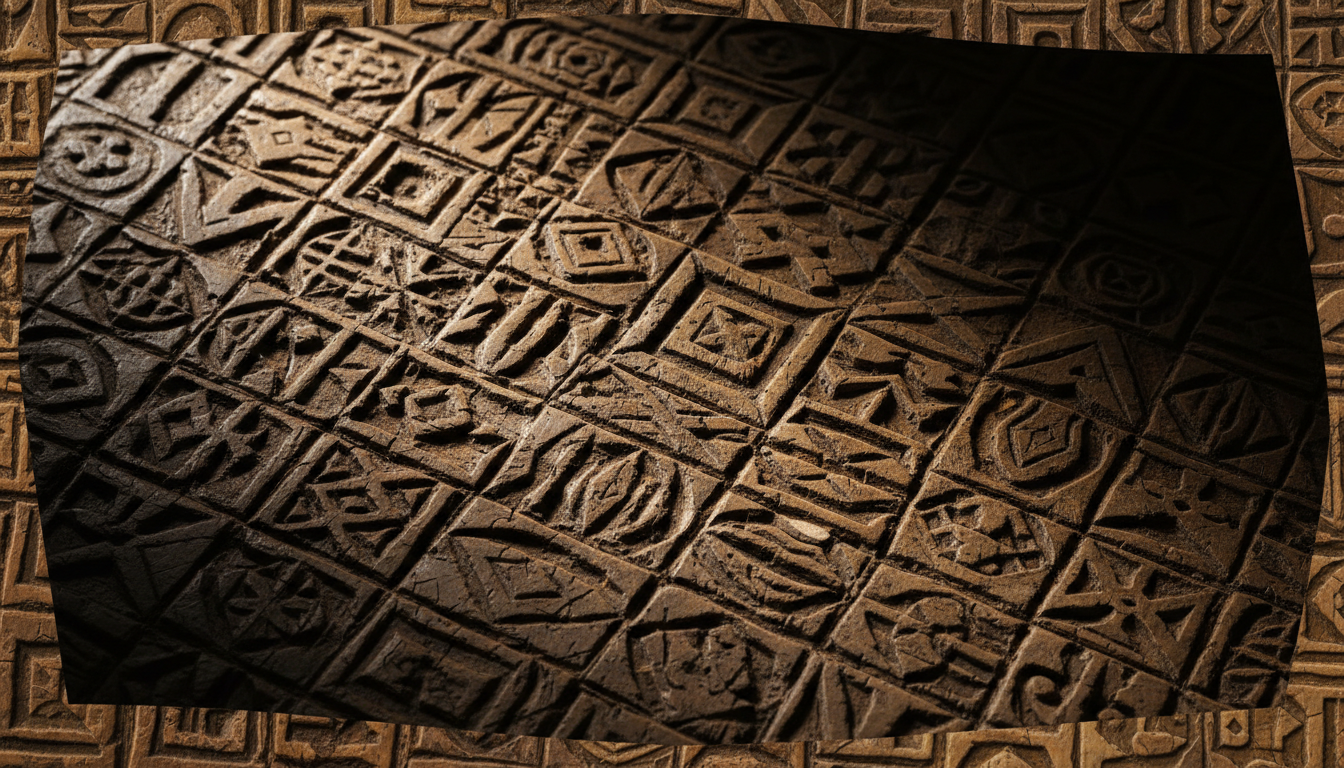
On the most isolated inhabited island on Earth, people carved rows of tiny figures, birds, fish, human shapes with raised arms, into pieces of wood, and then the last people who could read them died. Nobody has read rongorongo since. Around that silence two rival theories grew. The first, launched in Paris in 1932, held that the Easter Island glyphs were so close to the signs of the Indus Valley, on the other side of the planet and thousands of years older, that the two scripts must be related, which would mean a lost link between ancient civilisations that history books never mention. The second holds the opposite: that the islanders never invented writing on their own at all, and only began carving glyphs after Spanish visitors held a ceremony on the island in 1770, when islanders were recorded writing with a quill. A single piece of wood, dated in 2024, now sits at the centre of the fight.
The Indus theory began in a lecture hall. At the Académie des Inscriptions et Belles-Lettres on 16 September 1932, the sinologist Paul Pelliot presented "Lettre de M. de Hevesy sur une écriture mystérieuse du bassin de l'Indus" (https://www.persee.fr/doc/crai_0065-0536_1932_num_76_3_76240). The Hungarian scholar Guillaume de Hevesy had sent him tables of signs, pinned to the walls of the room, setting Indus seals beside Easter Island tablets. The minutes admit that it was hard to see how two groups of monuments "si éloignés dans l'espace et dans le temps" could be linked in history. Yet the tables showed "une telle analogie et souvent une identité si complète" that the hypothesis of kinship gained a certain plausibility. Mere likeness of signs whose meaning is unknown proves nothing by itself, the minutes note, but here the accumulated resemblances were such that the question "paraît vraiment se poser," seemed really to arise.
Hevesy made his own case the next year in "Sur une Écriture Océanienne paraissant d'origine néolithique," a lecture to the Société Préhistorique Française on 22 June 1933 (https://www.persee.fr/doc/bspf_0249-7638_1933_num_30_7_12178). He opened by asking his audience to question him hard, saying few subjects called for more caution. Then he set the scene: only ten years earlier no one had suspected the Indus civilisation existed, with Mohenjo-daro's planned streets, multi-storey houses with bathrooms, and vaulted drains "presque la dimension de ceux de Paris." A civilisation that advanced, previously unknown, was his starting point for a script that he thought had travelled, or descended, to the far Pacific. For readers who believe in a forgotten diffusion of knowledge, the 1933 lecture is still a founding text.
The 2024 study that reopened the timing question is "The invention of writing on Rapa Nui (Easter Island). New radiocarbon dates on the Rongorongo script," by Silvia Ferrara and colleagues in Scientific Reports (https://www.nature.com/articles/s41598-024-53063-7). Rongorongo survives on fewer than 30 wooden objects, none still on the island; outsiders first noticed it in 1864, and missionaries sent most tablets abroad in the 1860s and 1870s, while some were deliberately destroyed. The team dated four tablets kept in Rome. Three came out in the nineteenth century. The fourth, Tablet D, called Échancrée, gave a felling date of 1493 to 1509, centuries before Europeans arrived in the 1720s. The wood is Podocarpus latifolius, native to southeastern Africa, and never grew on Rapa Nui. The paper is careful: it records the 1770 ceremony where islanders were seen writing with a quill, and says the dates "do not allow to reach any incontrovertible conclusion" on whether rongorongo came from contact or was an original invention. Its glyphs, the authors add, look like no known script and come closest to motifs in the island's own rock art.
Nature Italy's research highlight, "Reading between the lines on an ancient island script" (https://www.nature.com/articles/d43978-024-00037-y), put the stakes plainly. The engraved tablet "has been identified as centuries older than the European colonisation of the island," supporting the idea that a local writing system "may have been invented independently." If so, rongorongo "could be the most recent example of independent invention of writing in history." The work was led by the philologist Silvia Ferrara and the radiocarbon chronologist Sahra Talamo at the University of Bologna.
Live Science's coverage, "Undeciphered script from Easter Island may predate European colonization" (https://www.livescience.com/archaeology/undeciphered-script-from-easter-island-may-predate-european-colonization), carried Ferrara's own view. She told the site the results support the idea that rongorongo was an original invention by the Rapa Nui rather than a response to the writing they saw Europeans use, and the article notes that the glyphs look nothing like European letters.
The sharpest reply came from two computational linguists. Kyle Gorman and Richard Sproat, writing on Language Log as "Was rongorongo an independent invention of writing?" (https://languagelog.ldc.upenn.edu/nll/?p=63139), point out that the texts were mostly carved on driftwood that washed ashore, and that dating the wood "merely provides a terminus post quem," as the authors admit: the earliest the carving could be, not when it happened. Échancrée was not found in an archaeological context, so no one knows when the African wood reached the island or when it was inscribed, and the paper offers no mechanism for how it got there between 1500 and the early 1700s. In principle, a tree felled around 1500 could have been carved centuries later.
Rongorongo is a real script that no one can read, carved on fewer than 30 surviving wooden objects. Hevesy argued in 1932 and 1933 that its glyphs match the Indus script, implying a lost link; others say it was inspired by the writing islanders saw at a Spanish ceremony in 1770. A 2024 date of 1493 to 1509 for one tablet's wood has revived the case for independent invention, but it dates the tree, not the carving.
What Stays Contested
Everything that matters is still open: what the glyphs say, when they were first carved, and whether the idea of writing reached the island from outside. Without a reading, likeness to Indus signs cannot be tested, and without a dated carving, the wood dates cannot settle the contact question.