
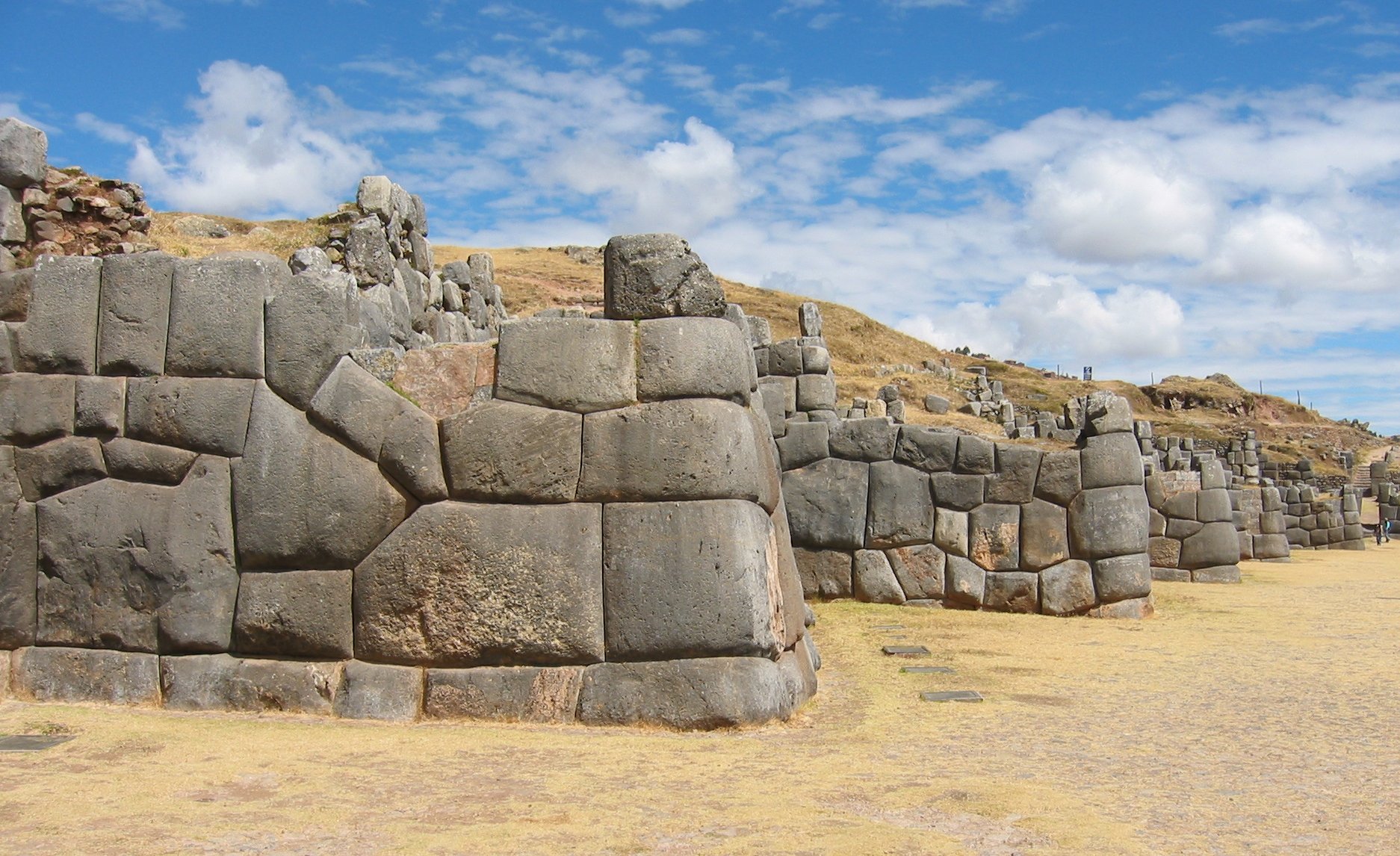
Above Cusco, the zigzag terraces of Sacsayhuamán still stop cameras for the same reason they stop engineers: polygonal blocks of andesite and related stone fitted without mortar, joints tight enough that tourist knives become folklore props. Spanish accounts and later archaeology place the complex in the Inca imperial building program that remade Cuzco under Pachacuti and his successors. UNESCO’s City of Cuzco listing frames meticulously cut granite and andesite walls as Inca urban technology. Jean-Pierre Protzen’s quarry and stonecutting fieldwork shows how those walls were made with hammerstones, pecking, and patient fitting. This Archive file is documented. The tension is Inca engineering on the heritage record versus viral “impossible stone / alien” captions—not a baptism of extraterrestrial architects.
Zigzag Walls Above the Capital
Sacsayhuamán crowns the heights north of the old Inca city. Three principal terraces run in serrated plans; some blocks are many tons; faces are dressed into irregular polygons that lock to neighbors. Function debates continue—fortress, ceremonial stage, both—but authorship does not require a mystery civilization. The same masonry grammar appears in Cusco streets and at highland sites in the imperial network. Labor drafts (mit’a), road logistics, and quarry catchments belong to Tawantinsuyu statecraft, not to a missing nonhuman contractor.
PROMPERÚ presents the site as an Inca archaeological complex for visitors. That tourism language still points at Inca builders. It does not point at spacecraft. The famous twelve-angled stone on Hatun Rumiyoc in the city below is the same technical family: pecked contacts, slight convexity and concavity, interlocking without mortar. Sacsayhuamán simply scales the grammar into fortress-terrace monumentality.
Peru.travel — Sacsayhuamán: https://www.peru.travel/en/attractions/sacsayhuaman.
Spanish siege narratives made the hill famous as a fortress in 1536. Later archaeology complicated simple military readings—platforms, enclosures, and sightlines also suit ceremony and state display—without removing Inca agency. Wonder at scale is allowed. Wonder that deletes Indigenous engineers is not the Archive’s thesis.
What Field Engineering Keeps Showing
Protzen’s Cusco-region work tracked quarry faces, abandoned blocks, and dressing marks. At Rumiqolqa and related sources, andesite could be extracted and shaped with stone tools harder than the workpieces. Builders pecked contact faces, tested fits, and adjusted concave and convex seats so stones locked. Recessed joints throw shade; irregular outlines are aesthetic as well as structural. In a seismic landscape, interlocking dry stone that can shift slightly without collapsing is not a paradox. It is a design outcome visible in standing walls that outlasted many colonial rebuilds after earthquakes.
Protzen Berkeley AnthroPubs PDF: https://digitalassets.lib.berkeley.edu/anthpubs/ucb/text/nap021-006.pdf.
Protzen JSAH 1985: https://www.jstor.org/stable/990060.
Transport stories matter as much as dressing. Blocks moved from quarries along prepared routes; some were abandoned mid-journey and still show incomplete faces. That unfinished trail is the opposite of a magician’s flourish. It is a construction site frozen in logistics. Experimental pecking reproduces the characteristic pitted surface left by hammerstone work. Nothing in that toolkit requires laser cutting, soft-stone recipes from space, or giant unknown precursors as fact. Quarries, roads, and labor already explain the famous precision within Andean imperial history.
UNESCO Custody Language
The World Heritage Centre’s City of Cuzco brief synthesis stresses stone construction technology with exceptional aesthetic and structural properties—Qoricancha and related compounds, rectilinear streets inside Inca walls, colonial churches rising on Inca foundations. Integrity language still worries about earthquakes, overuse, and tourism pressure on fabric. Authenticity language leans on physical street plans and colonial-era witness documents. That is heritage management, not a confession that the walls are inexplicable.
UNESCO City of Cuzco List 273: https://whc.unesco.org/en/list/273/.
UNESCO documents hub: https://whc.unesco.org/en/list/273/documents/.
The Historic Sanctuary of Machu Picchu carries a parallel Inca dry-stone and polygonal dossier in the same imperial tradition. Listing 274 is a neighbor door for engineering continuity across highland sites, not a claim that Sacsayhuamán sits inside that sanctuary boundary. Read together, the two inscriptions show how Peru and UNESCO file cut-stone Inca architecture as documented cultural achievement under active conservation loads.
UNESCO Machu Picchu List 274: https://whc.unesco.org/en/list/274/.
Impossible-Stone Folklore
Viral captions treat a knife blade in a joint as a physics miracle and then leap to aliens, lost laser guilds, or pre-Inca mega-civilizations that somehow left no quarry trail matching the walls. Documented filing records that folklore as media ecology. It does not promote it to peer architecture history. Gaps in room function or construction sequence are normal archaeological problems. They are not licenses to erase Inca stonemasons. “Too perfect for humans” is a slogan, not a stratigraphic report. The paperwork on this shelf is quarry survey, World Heritage text, and standing walls that still flex in Andean quakes.
What Documented Settles
Settled for documentary purposes: Sacsayhuamán’s monumental polygonal terraces belong to the Inca imperial masonry tradition around Cusco; dry-stone polygonal fitting is a documented Andean technique studied in quarry and wall surveys; UNESCO Cuzco language treats cut-stone walls as Inca urban achievement under heritage protection; Protzen’s pecking-and-fitting account is the specialist foil to “impossible” slogans. Still open as research detail: exact construction chronology for every terrace phase, full functional mapping of enclosures, and ongoing conservation under tourism load. Those open questions do not reopen alien authorship.
Readers who want only alien lasers will not be moved by a hammerstone quarry. Readers who want only sneer will miss why UNESCO integrity language still worries about tourism load on the same walls. The file holds engineering, World Heritage paperwork, and caption folklore on one page without converting either into a sermon.
The tension that remains is caption versus paperwork. Officials and architectural historians argue about quarries, hammerstones, and World Heritage fabric. Viral clips argue about stones that “cannot” be Inca. Sacsayhuamán is that argument—read with UNESCO and Protzen open, and with extraterrestrial builders left labeled as folklore.