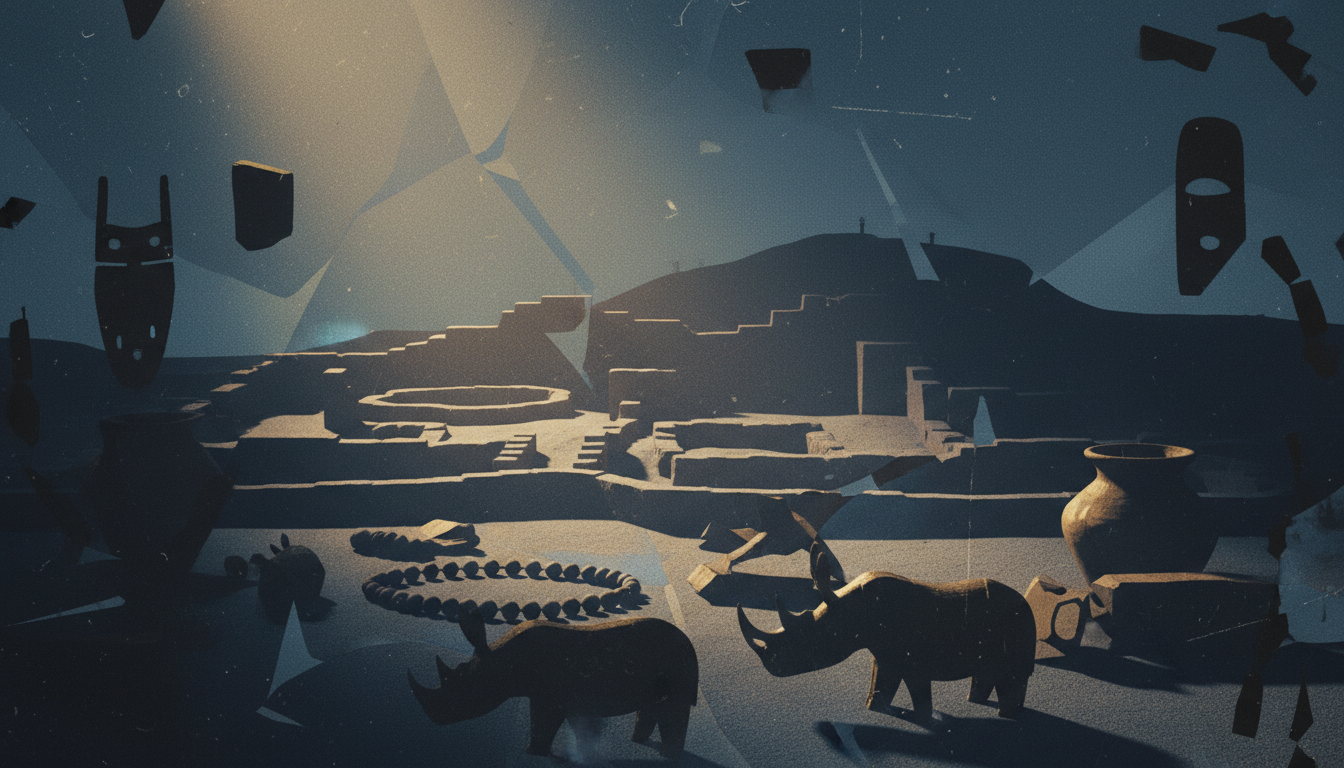
At the confluence of the Limpopo and Shashe rivers, where South Africa meets Zimbabwe and Botswana, the Mapungubwe Cultural Landscape preserves the archaeological sequence of southern Africa’s first large indigenous kingdom. Between roughly 900 and 1300 CE, capitals shifted from Schroda through the Leopard’s Kopje/K2 complex to the sandstone summit of Mapungubwe Hill, where a secluded elite was buried with gold foil sculptures, beads, a bowl, and a sceptre. UNESCO inscribed the landscape in 2003 as List 1099 under criteria (ii), (iii), (iv), and (v). South African National Parks manages the property inside Mapungubwe National Park; the University of Pretoria Museums curate the gold assemblage. This file is that heritage and burial paper trail—documented political complexity on the Limpopo frontier—not a colonial sermon that southern Africa lacked kingdoms until Europeans arrived, and not a mystical golden-rhino caption that floats free of excavation notes.
Capitals, Trade, Sacred Hill
UNESCO’s brief synthesis treats Mapungubwe as evidence for the rise and fall of the first indigenous kingdom in Southern Africa. Fertility at the river confluence supported dense settlement; control of north–south and east–west routes fed long-distance trade through East African ports toward India and China. Gold and ivory left the hinterland; Chinese porcelain and Persian glass beads arrived. Architecture and settlement planning changed with an elite class and sacred leadership: the king lived apart on the hill while commoners occupied the plains below. Climatic drying after about 1300 CE is the WH narrative for dispersal, with power later concentrating farther north toward Great Zimbabwe and Khami. Those are landscape and chronology claims published in the nomination and Centre listing—not nationalist folklore invented last week.
UNESCO List 1099: https://whc.unesco.org/en/list/1099/.
Nomination dossier PDF: https://whc.unesco.org/uploads/nominations/1099.pdf.
SANParks’ cultural-history page restates the National Heritage Site declaration (2001), World Heritage inscription (2003), and the 1930s Greefswald discovery story: farm visitors climbing a concealed cleft found hilltop graves; University of Pretoria excavations under Leo Fouché secured the finds and mapped surrounding occupation. About twenty-three graves were recorded on Mapungubwe Hill in early campaigns; three elite burials carried gold. Class separation—hilltop sacred leader, plains commoners—is the social reading SANParks and the dossier share. Peak population estimates in park interpretation run on the order of thousands, not a hamlet pretending to be a state.
SANParks cultural history: https://www.sanparks.org/parks/mapungubwe/explore/natural-cultural-history.
Gold Burials and University Custody
The objects that made Mapungubwe famous are funerary gold from those hilltop graves: thousands of beads; foil fragments once sheathing carved wooden forms; a bowl; a sceptre; and the golden rhinoceros, a small foil-over-wood figurine that has become a national emblem. Dating for the gold phase clusters in the thirteenth century CE within the wider kingdom span. Originals live in the University of Pretoria Mapungubwe Collection; the park’s interpretation spaces rely on high-quality replicas so the landscape visit and the metalwork visit are deliberately split. UP Museums publish collection and object notes on the rhinoceros as curated national treasure. The South African state named its highest honour for excellence the Order of Mapungubwe, tying modern civic symbolism to the same archaeological name without converting the Order page into an excavation report.
UP Mapungubwe Collection: https://www.up.ac.za/museums-collections/university-of-pretoria-mapungubwe-collection.
UP gold rhinoceros note: https://www.up.ac.za/museums-collections/news/international-world-rhino-day-one-and-only-gold-rhino-world-university-of-pretoria.
Order of Mapungubwe: https://www.gov.za/about-government/order-mapungubwe.
Early twentieth-century dig standards left integrity problems the WH text itself flags: valuable evidence lost to 1930s methods. That admission is part of documentary honesty, not a reason to discard the gold or the settlement sequence. Mining pressure beyond the buffer and elephant reintroduction inside the park are living management issues on the Centre page. They are conservation politics, not proof that the kingdom was imaginary.
Trade goods in the nomination—glass beads, spindle whorls, porcelain fragments—anchor the east-coast commercial story in excavated inventory rather than in romantic caravan fiction. Hilltop seclusion is an architectural and mortuary pattern: graves and palace residues on the summit, dependent settlement below. Reading that pattern as sacred leadership is the WH synthesis; reading it as proof of later colonial emptiness is the denial this file refuses.
Against Colonial Denial Historiography
Settler and apartheid-era historiography often minimized or denied complex African polities south of the Limpopo, preferring empty-land myths or foreign-builder scripts of the kind that also haunted Great Zimbabwe debates. Mapungubwe’s hilltop graves, trade imports, and capital sequence are the archaeological rebuttal: indigenous state formation, craft gold-working, and Indian Ocean commercial entanglement are on the dossier, not in a pamphlet of denial. Corrective heritage politics after 1994—including WH inscription and the Order—can sound ceremonial; the corrective still rests on excavated graves and survey, not on inventing a larger empire than the evidence carries. Foreign civilizers and lost white kingdoms remain folklore foils. Chinese porcelain at Mapungubwe records exchange, not overseas founders planting a rhinoceros overnight.
Wonder at foil gold and sacred seclusion is allowed. Wonder that needs Europeans or Atlantis to explain southern African hierarchy is not. The file holds SANParks landscape custody and UP metalwork custody in one documentary frame: the kingdom was African; the gold was buried on an African hill; modern South African institutions conserve both.
What Documented Settles
Settled for documentary purposes: Mapungubwe Cultural Landscape is UNESCO-listed; the capital sequence and elite gold burials are published; UP Museums hold the gold; SANParks manages the park landscape; the Order of Mapungubwe carries the name into state honours. Still open as normal archaeology and management: finer climate-demise models; buffer mining risk; how much early excavation destroyed. Those open questions do not reopen colonial denial that no complex polity existed here, and they do not authorize foreign-builder captions that steal credit from Limpopo makers. Mapungubwe is documented southern African statehood and gold burial archaeology—read with UNESCO, SANParks, UP, and gov.za doors open, and with empty-land folklore left off the hill.