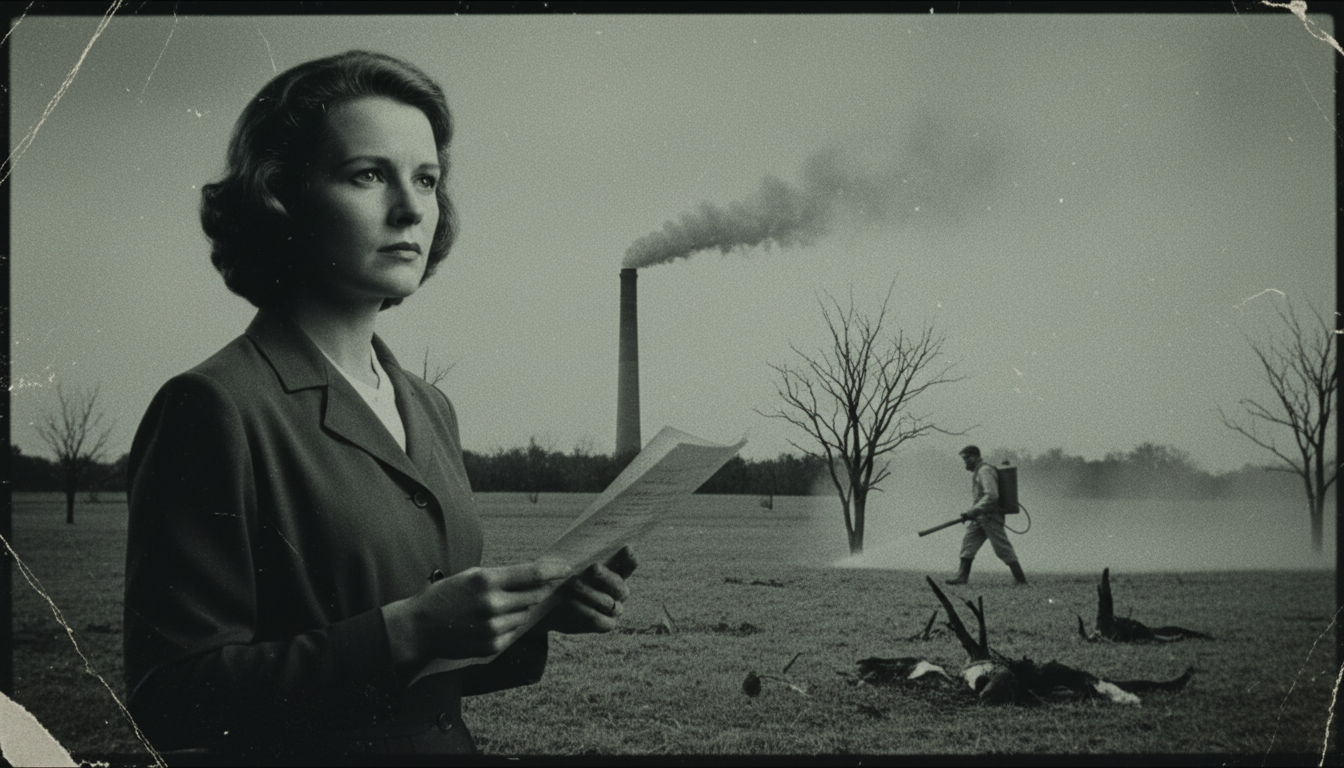
Rachel Carson’s Silent Spring appeared in 1962 and turned a specialist worry about persistent insecticides into a public argument. DDT—dichloro-diphenyl-trichloroethane—had been a wartime and public-health success story: cheap, effective, famous for typhus and malaria control. The same persistence that made it useful made it accumulate in food chains. EPA’s own later histories credit Carson with forcing intensive investigation. What followed was not an overnight ban. It was a decade of USDA reviews, industry pushback, court remands, a marathon cancellation hearing, and a 1972 Administrator’s order that overruled the hearing examiner on remaining U.S. crop uses.
From Wonder Chemical to Docket
Scientists had flagged hazards as early as the mid-1940s. Carson gave the public a narrative of silent birds, biomagnification, and regulatory failure. USDA canceled some uses in 1969—Dutch elm, tobacco, home and aquatic applications among them—while informal review of remaining uses continued. When the Environmental Protection Agency opened in December 1970, pesticide authority shifted into a new house with a different risk vocabulary. In early 1971 EPA moved formal FIFRA cancellation against remaining DDT registrations. Registrants and formulators—including Montrose Chemical as the sole U.S. manufacturer in the hearing record—contested. Environmental Defense Fund litigation had already pushed courts to treat cancellation as a serious administrative duty rather than a polite suggestion.
EPA — DDT Regulatory History (to 1975): https://www.epa.gov/archive/epa/aboutepa/ddt-regulatory-history-brief-survey-1975.html
EPA Archive — Rachel Carson: https://www.epa.gov/archive/epa/aboutepa/rachel-carson.html
Official Posture: Risk, Benefit, and Substitutes
The agency’s public posture framed DDT as persistent, mobile, and biologically magnifying, with toxicological concerns and diminishing unique benefits once substitutes existed. Industry and some agricultural witnesses answered with a counterattack familiar in pesticide dockets: alternatives were more acutely toxic to applicators, costlier, or less effective on cotton and other crops; wildlife harms were overstated or caused by misuse; human epidemiology did not justify panic. That fight was not a press conference. It was sworn testimony, exhibits, and an examiner’s report.
What the Hearing Record Shows
Hearing Examiner Edmund M. Sweeney’s consolidated DDT hearing produced findings that, on several counts, favored continued “essential” uses and vacating cancellation notices—risk-benefit language that industry could live with. Administrator William D. Ruckelshaus did not adopt that destination. His Opinion and Order of 30 June 1972 (announced in mid-June for a year-end effective date on remaining crop uses) canceled those registrations based on persistence, transport, biomagnification, toxicological effects, and the availability of less damaging substitutes. Public-health, quarantine, and export uses were carved differently. EPA and USDA spun up “Project Safeguard” to train users on organophosphate substitutes. Industry sued to kill the order; EDF sued to widen it. Appeals consolidated in the D.C. Circuit.
EPA — Ruckelshaus DDT Opinion and Order: https://www.epa.gov/archive/epa/sites/production/files/documents/DDT-Ruckelshaus.pdf
EPA — Hearing Examiner Section A: https://www.epa.gov/archive/epa/sites/production/files/documents/ddt_A.pdf
EPA — Hearing conclusions packet: https://www.epa.gov/archive/epa/sites/production/files/documents/1972_EPA_DDT_hearing.PDF
Why the Counterattack Matters
The “counterattack” is not a conspiracy caption. It is the documented registrant defense inside FIFRA process—USDA-era skepticism of abrupt cancellation, manufacturer and formulator petitions, scientific witnesses disputing carcinogenicity and wildlife causation, and an examiner willing to keep essential agricultural uses. Ruckelshaus’s overruling is the other documented half: an Administrator exercising final cancellation authority after a full record, not a book-burning. Carson opened the gate; the docket decided the crop-use fate.
EPA — DDT Brief History and Status: https://www.epa.gov/ingredients-used-pesticide-products/ddt-brief-history-and-status
Myth Discipline
Documented: Carson 1962 as catalytic public event; USDA partial cancellations; EPA FIFRA cancellations; Sweeney hearing record; Ruckelshaus 1972 order ending remaining U.S. crop uses effective 31 December 1972; limited exceptions. Overclaim to refuse: “Carson banned DDT by herself in 1962,” “EPA banned all DDT worldwide,” and “the hearing proved DDT harmless.” Global malaria vector-control exceptions under later international regimes are a separate policy track—cite EPA status language, do not import Tonight-Show epidemiology. Domestic shipments in the early 1970s still measured in millions of pounds; the ban terminated a live market, not a museum piece.
Read the examiner and the Administrator as a pair. Sweeney’s record shows how far a benefit-risk framing sympathetic to continued agricultural DDT could travel inside the same statute Ruckelshaus used to cancel. That disagreement is the Archive’s hinge: not whether Carson wrote a famous book, but how a chemical’s wartime reputation survived into a contested administrative trial—and lost on the Administrator’s signature.
Date discipline: 1962 book; 1969 USDA actions; EPA 1970; 1971 cancellation notices and EDF v. Ruckelshaus remand weather; examiner April 1972; Administrator June 1972; effective date year-end 1972.
EPA’s later status pages still describe DDT’s persistence and the 1972 agricultural cutoff while noting narrow disease-vector and research contexts elsewhere. That continuity matters: the counterattack lost the U.S. crop market, not the molecule’s entire global biography. Keep the captions separate—Ruckelshaus order for domestic crop uses; Stockholm-era vector debates for another docket.
Cotton dominated domestic tonnage in the late hearing years; sweet peppers and other specialty uses appeared as contested niches. The Administrator’s order treated agricultural convenience as insufficient against persistence and ecological transport findings. That sentence—benefits insufficient relative to risks given substitutes—is the cancellation’s legal spine, not a cultural mood.
What the Paper Trail Settles
Settled on the documents: Silent Spring forced DDT onto the national docket; industry and agricultural interests fought cancellation through formal hearings; the examiner and the Administrator disagreed; the Administrator’s order canceled remaining U.S. crop uses. Officials argued risk and benefit. The paper trail preserves both the counterattack and the overruling—read them together, not as folklore.