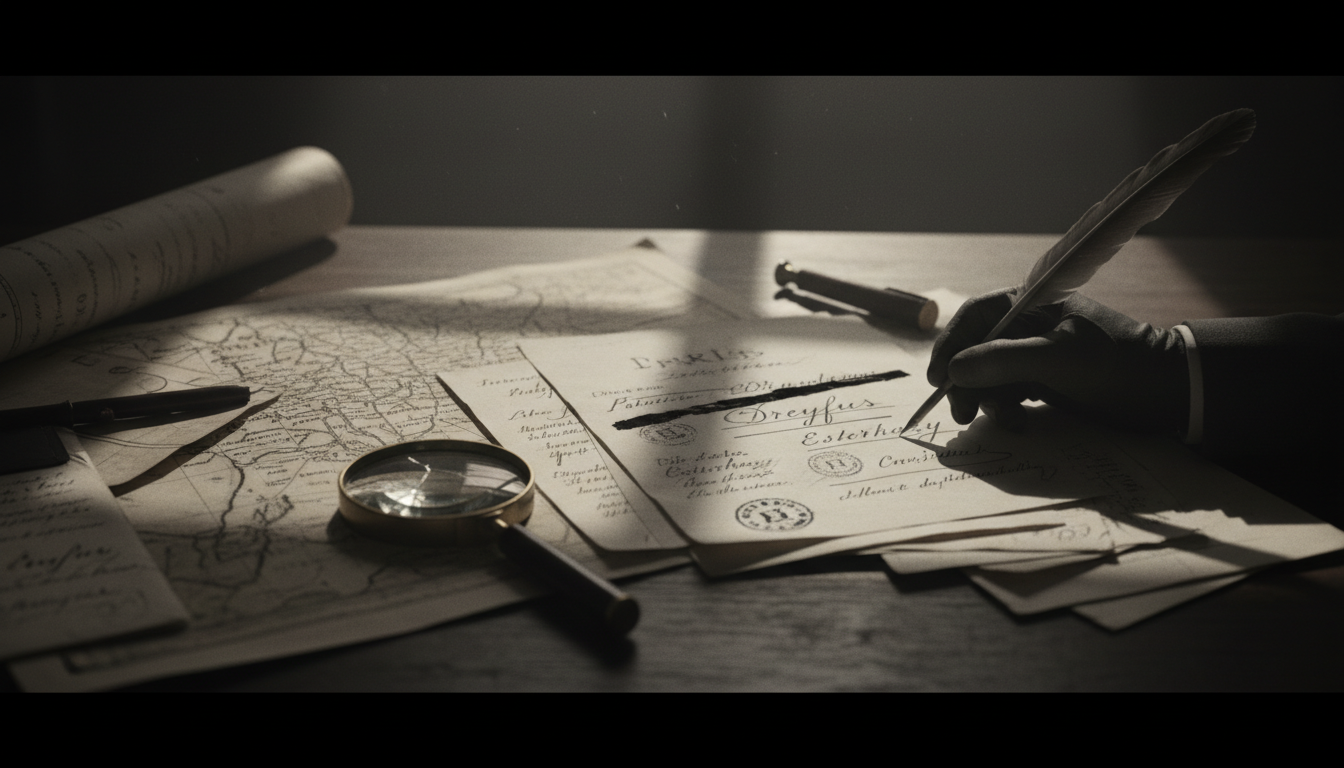
In 1894 French counter-espionage intercepted an unsigned bordereau offering military secrets to the German embassy. Staff officers matched the handwriting to Captain Alfred Dreyfus, convicted him in a closed court-martial, and shipped him to Devil’s Island. The official line held that the bordereau and a secret dossier proved guilt.
In 1894 French counter-espionage intercepted an unsigned bordereau offering military secrets to the German embassy. Staff officers matched the handwriting to Captain Alfred Dreyfus, convicted him in a closed court-martial, and shipped him to Devil’s Island. The official line held that the bordereau and a secret dossier proved guilt. The archival and high-court trail shows something harder: a catastrophic first identification defended with forged supports—most notoriously the faux Henry—while antisemitism in the general staff and honor culture treated admitting error as worse than compounding it. Exoneration came. The template for state forgery scandals remained.
The Product: Bordereau and Secret Dossier
The bordereau was the charging engine. Handwriting expertise, staff prejudice, and closed procedure turned an unsigned note into a conviction. A secret dossier withheld from the defense thickened the case. Facsimiles and cote inventories in the Musée d’art et d’histoire du Judaïsme’s Alfred Dreyfus fonds preserve the bordereau dossier trail for researchers who want paper, not legend.
Mémoire des Hommes, the Ministry of the Armed Forces portal, opens the military-justice “dossier secret” associated with Dreyfus for public research. That door matters more than novelizations. Prefer it when secondary essays recycle plot without carton language. Prefer carton language over Britannica-only spines.
Official Posture: Honor, Secrecy, Esterhazy Cleared
Army spokesmen and ministers framed the conviction as settled justice. When evidence pointed toward Major Ferdinand Walsin Esterhazy, institutional reflex protected the first verdict. Lieutenant Colonel Georges Picquart’s warnings were sidelined. Esterhazy was cleared. Forgeries entered the secret dossier to shore up a case that could not survive daylight. Antisemitic press camps and leagues turned the Affair into a national referendum. Émile Zola’s J’Accuse…! made the cover-up a European public event. Press politics were real. They do not replace the forged paper.
What the Paperwork Shows
Archives nationales series BB19 holds judicial procedure materials and scellés from the Affair—papers seized and assembled for courts that later had to face their own record. The BnF manuscript department preserves Dreyfus-family correspondence and related documents under NAF 17386–17387. FranceArchives’ historical page on the Cour de cassation’s 12 July 1906 ruling states the institutional endgame: combined chambers annulled the Rennes military conviction without referral, declaring that nothing remained of the accusation, and ordered publication in the Journal officiel. The Assembly’s heritage dossier tracks the parliamentary path that restored Dreyfus’s rank.
The faux Henry—Commandant Hubert-Joseph Henry’s fabricated piece meant to implicate Dreyfus via forged embassy traffic—collapsed under scrutiny in 1898. Henry confessed and died by suicide in custody. That sequence is not folklore. It is why “forgeries” belongs in the title rather than as color. Handwriting error opened the door; forged supports tried to weld it shut.
Why the Story Stayed Managed
Military honor culture treated institutional error as existential threat. Antisemitism supplied motive energy, not background scenery. Ministers and editors chose camps. Revisionist attempts to restore Dreyfus-as-spy fight the cassation record and the archival dossier trail. The Archive’s adherent-evidence job is to keep bordereau, faux Henry, BB19 procedure, and 1906 rehabilitation on the same page—and to refuse modern “deep state” slogans the 1890s cartons do not carry.
From Court-Martial Darkness to Combined Chambers
The 1894 court-martial ran on closed evidence rules that starved the defense of the secret dossier. Rennes in 1899 retried Dreyfus under political storm and still produced a guilty verdict with extenuating circumstances—an institutional half-measure that satisfied neither camp. Presidential pardon followed as politics, not as archival clearance. Only the Cour de cassation’s 1906 combined-chambers judgment cut the accusation to nothing and refused referral to yet another military court. That sequence matters: pardon is mercy; cassation without referral is legal annihilation of the charge. FranceArchives and the Assembly heritage pages are the public doors; BB19 and Mémoire des Hommes are the carton doors. Prefer both layers when cable-news summaries collapse pardon into “exoneration” without naming the high court.
Public Sphere Weaponized
Newspapers, leagues, and intellectuals made courts-martial into mass politics. That form—state secrecy, leaked facsimiles, celebrity interventions—became a European template for later wrongful-conviction fights. Cross-link sibling state-forgery pages for method. Do not clone their evidence lists onto this one. Date discipline stays with the docket: bordereau summer/autumn 1894; conviction December 1894; Picquart–Esterhazy turn 1896–98; Henry exposure August 1898; Rennes retrial 1899; cassation rehabilitation 12 July 1906.
What the Paper Trail Settles
Settled on the documents: misattribution of the bordereau; secret-dossier practice; Henry’s forgery and confession; Cour de cassation annulment without referral; parliamentary restoration of rank. Overclaim to refuse: fringe guilt restorations; treating every antisemitic pamphlet as a courtroom exhibit; erasing either antisemitism or honor culture as if one motor deleted the other. Officials said treason proven. The paper trail says institutions defended a first lie with forged paper—until the high court and the archives broke the seal.