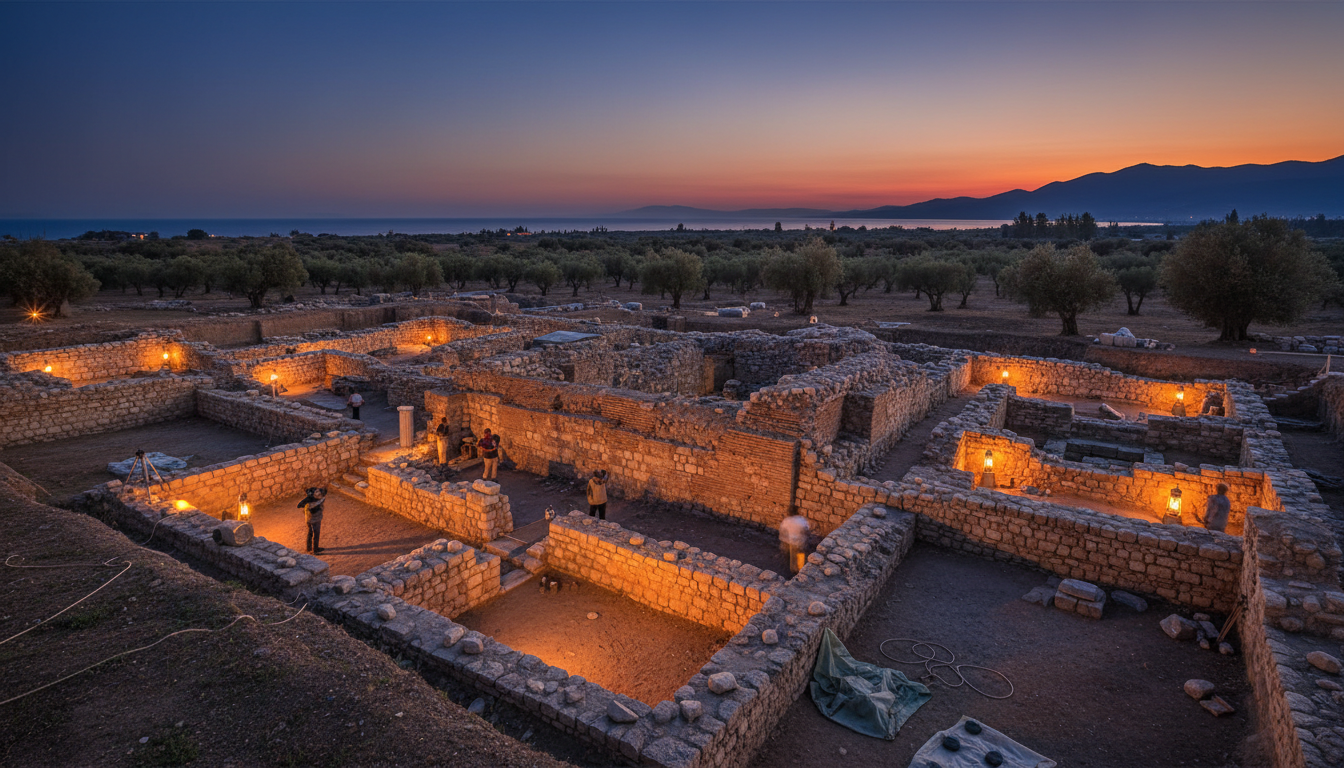
Digging Up a Poem
Nineteenth-century classical scholarship often treated Homeric Troy as literary invention—useful for Greek identity, useless as a dig site. Amateur passion and Ottoman-era excavation politics overturned that complacency when Heinrich Schliemann, guided in part by local antiquarian Frank Calvert's identification of Hisarlık in northwestern Anatolia, sank trenches into a multi-layered mound and announced he had found Troy.
Schliemann at Hisarlık
Schliemann's campaigns from the early 1870s famously chased Homer's Iliad as a geographic dossier. He uncovered stacked prehistoric and Bronze Age settlements, publicized "Priam's Treasure" in 1873, and forced European academia to confront a real fortified city where myth had been parked. Britannica and Smithsonian historical retrospectives also record the damage: Schliemann's enormous trenches and weak stratigraphic control destroyed contexts later excavators would have protected, and his treasure dating was wrong—jewelry he tied to Priam belongs to an earlier Troy level (commonly Troy II), centuries before a plausible Late Bronze Age Homeric horizon.
Subsequent work by Wilhelm Dörpfeld, Carl Blegen, and later international projects refined the sequence. Many specialists now discuss Troy VI–VIIa as the most plausible candidates for a Late Bronze Age city that could underlie Greek war memory, complete with destruction horizons. "Homer was pure fiction" became untenable; "every Iliadic detail is reportage" never became tenable. Hittite texts referring to Wilusa and Ahhiyawa added an independent Anatolian documentary layer that twenty-first-century scholarship continues to integrate cautiously.
The stub narrative that "conspiracy theorists of the nineteenth century" were simply right needs Archive nuance: believers in a historical core to the epic were partly vindicated; treasure-hunt showmanship, smuggling controversies, and chronological errors were real. Calvert's earlier role is often underplayed in Schliemann-centric popular tellings.
Homeric Historicity Claims
Documented: Hisarlık is a major Bronze Age site generally identified with Troy; Homeric epic likely preserves distorted historical memory of Aegean–Anatolian conflict worlds. Romantic overclaim: that Schliemann "proved the Iliad true" battle-by-battle, or that academic disbelief was a conspiracy rather than methodological conservatism colliding with an unreliable narrator of finds.
In Archive taxonomy, Troy sits with other "myth became dig site" episodes: not proof that every epic is a field report, but proof that elite skepticism can miss a mound in plain sight when the wrong genre label is applied.
Layers Versus the Iliad
Classicists criticize Schliemann's ethics and diary embellishments. Archaeologists still argue which destruction layer, if any, matches a "Trojan War." Turkish and international teams continue fieldwork that quietly outruns both Victorian romance and internet certainty.
Status: site identification broadly accepted; Homeric historicity partial and debated. Troy is the template for "myth as compressed history"—and for how badly a true find can be excavated.
In Archive practice, Troy remains the clearest Western case that elite genre labels can hide a mound in plain sight—and that a true discovery can still be excavated so roughly that later generations spend decades repairing the damage.
For Archive readers, the lasting lesson is methodological: when a poem is treated as fiction by default, a city can hide under an unexcavated hill for generations—and when a digger finally arrives, careful stratigraphy matters as much as romantic conviction.