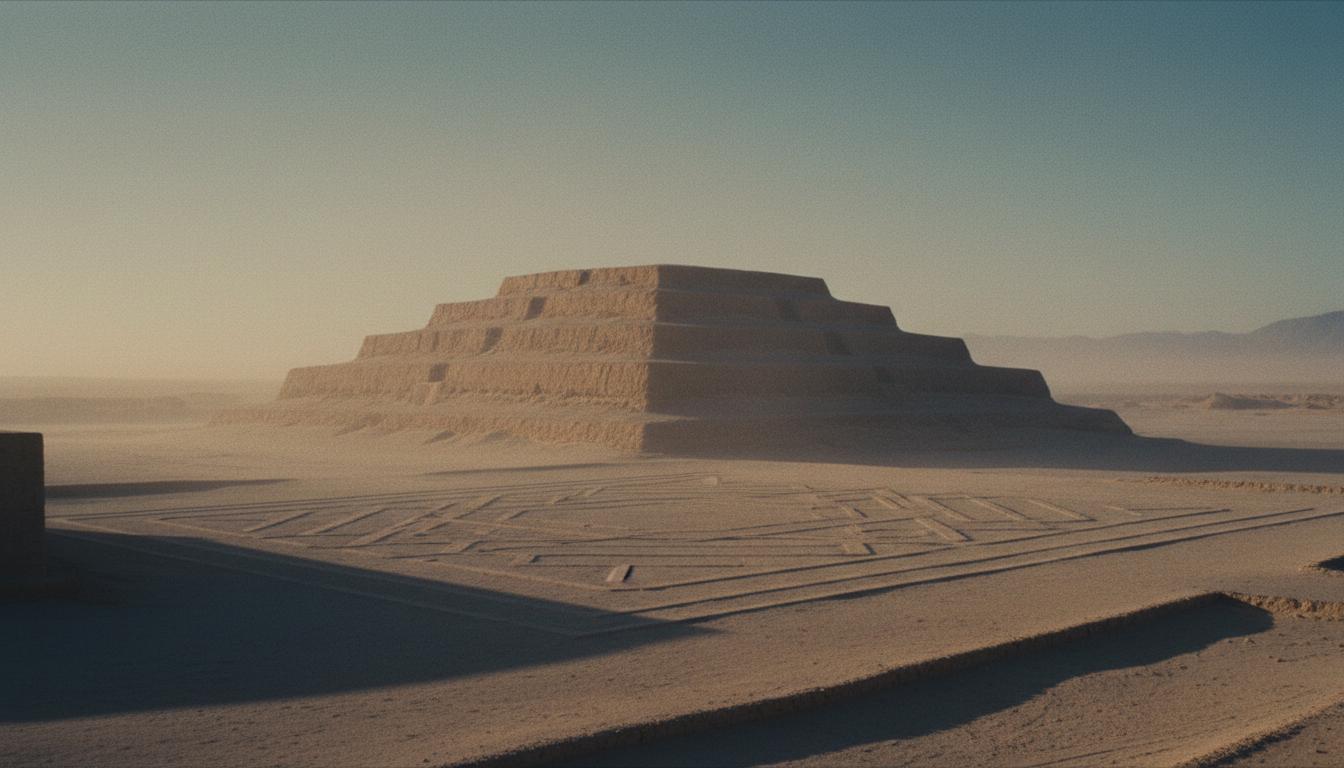
In the Supe Valley on Peru’s central coast, the Sacred City of Caral rises as a cluster of pyramidal platforms, sunken circular plazas, and residential architecture dated by radiocarbon into the third millennium BCE. UNESCO inscribed the site in 2009. Peru’s Zona Arqueológica Caral, long directed by Ruth Shady Solís, stewards excavation, conservation, and public interpretation. Popular and textbook shorthand calls Caral the oldest city in the Americas. Rank slogans travel faster than stratigraphic reports. This Archive file is documented. The shelf tension is early Andean urbanism versus civilization-score folklore—not a desert tourism caption.
The Valley and the Monumental Preceramic
Norte Chico / Caral-Supe research describes a suite of coastal and inland centers with platform mounds and plazas before ceramic pottery became common in the region. Caral is the flagship: large mounds, planned open spaces, and evidence of complex social organization without the later Andean package of ceramics and, in many tellings, without fortification-first warfare as the lead story. The point for documentary filing is not a contest slogan against Mesopotamia. It is that monumental urban construction on the Peruvian coast is older and more organized than older diffusion myths wanted to allow.
UNESCO Sacred City of Caral-Supe List 1269: https://whc.unesco.org/en/list/1269/.
UNESCO documents hub: https://whc.unesco.org/en/list/1269/documents/.
Shady, Zona Caral, and State Stewardship
Ruth Shady’s long-run project turned Caral from a little-known ruin into a national and World Heritage centerpiece. Zona Arqueológica Caral, as a Ministry of Culture executive unit, is the institutional door: research design, site protection, and interpretation under Peruvian state custody. The Plataforma del Estado Peruano officer page naming Shady as director of Unidad Ejecutora 003 is bureaucratic on purpose—credit and responsibility attached to a living institutional role, not to a lone explorer myth.
Zona Caral English portal: https://www.zonacaral.gob.pe/en/.
Zona Caral home: https://www.zonacaral.gob.pe/.
Gob.pe — Ruth Shady Solís: https://www.gob.pe/institucion/caral/funcionarios/18087-ruth-martha-shady-solis.
Radiocarbon and the 2001 Science Door
The 2001 Science paper by Shady, Haas, and Creamer on dating Caral pushed Supe Valley monumental chronology into global scholarly view. Later work refined and debated phases, but the publication remains a chronology door: charcoal samples, contexts, and a claim that major construction belongs in the third millennium BCE. Documented filing centers that radiocarbon argument rather than a mystical “sudden civilization” narrative. Priority disputes and credit fights around early publicity are part of the research history; they do not erase the mounds or the dates.
Science — Dating Caral (2001): https://www.science.org/doi/10.1126/science.1059519.
Rank Folklore and Diffusion Weather
“Oldest city in the Americas” is a phrase built for headlines. It compresses regional complexity into a trophy. Diffusionist and mystery-media habits sometimes answer that trophy with Atlantis, lost fleets, or Andean paleocontact—anything except local preceramic innovation. Cookie-stripped stub language once left Caral thin after adjacency polish; the Goldsboro job is to restore WH and Zona Caral spine so rank folklore does not refill the vacuum. Documented filing allows comparative age talk only as radiocarbon and excavation talk, not as a civilization Olympics medal ceremony.
Why Documented Still Has Teeth
Settled on the packets: Caral-Supe as a monumental preceramic urban center in the Supe Valley; UNESCO inscription 2009; Zona Arqueológica Caral stewardship under Peru’s Ministry of Culture; radiocarbon publication establishing early third-millennium BCE construction claims for major architecture. Overclaim to refuse: non-Andean authorship, astronaut engineers, and any single “oldest on Earth” absolutism that the WH dossier does not require.
The Archive tension is who owns early urban narrative in the Americas. Peruvian institutions present a researched Sacred City. Rank-and-mystery media present a trophy or a riddle. The file holds the UNESCO and Zona Caral doors against both trophy flattening and alien captions.
Archive Siblings
Chavín de Huántar is a later Andean ritual-urban neighbor on the Archive shelf—not a clone, not a replacement chronology. Other Norte Chico valley sites belong in the same early monumental conversation. Keep Caral on the Supe Valley and WH spine rather than a pan-Andean mystery mash.
Urban Dirt Versus Trophy Language
Platform fill, plaza plaster, and bagged charcoal are slow evidence. “First city” is fast language. Documented filing privileges the slow package. Trophy language is reception—useful for understanding why Caral went viral in education media, dangerous when it substitutes for excavation reports. Cookie P2-C once removed adjacency cookies from a thin live body; this rewrite restores substance so the page is not a vacuum for civilization-rank listicles to recolonize.
Preceramic Does Not Mean Primitive
Public captions sometimes hear “before pottery” as “before complexity.” Caral’s mounds and plazas refuse that slide. Preceramic here names a material horizon, not a civilizational deficit. Documented filing keeps that vocabulary archaeological. Mystery media that need Caral to be either a supreme first or an impossible anomaly are fighting trophy logic, not reading fill layers.
What the Paper Trail Settles
Settled: Sacred City WH listing; Zona Caral institutional custody; Shady-led research prominence; radiocarbon arguments for third-millennium BCE monumental construction; Norte Chico as a regional early complex society frame. Still research-active: internal phasing, relations among valley sites, economic networks to the coast and highlands, and how to compare Caral’s urbanism with other early centers without slogan wars. Those open questions are ordinary Andean archaeology.
The tension that remains is stewardship versus rank folklore. Officials present a World Heritage preceramic city with radiocarbon paperwork. Captions present a trophy or an impossible anomaly. Caral-Supe is that fight—read with UNESCO List 1269 and Zona Caral open, and with civilization-score slogans left labeled as claim.