Some believe the crew of the Carroll A. Deering did not simply abandon their ship off Cape Hatteras in January 1921. They believe the men were taken: by pirates, by rum runners, or by agents seizing American ships for Soviet Russia. The schooner was found aground with her sails set and her crew, boats, log and instruments gone. Five federal departments looked into it, the State Department went on record suspecting foul play, and no one has ever learned what happened. The Deering is often listed among Bermuda Triangle cases; her own record is strange enough without it.
Aground with sails set
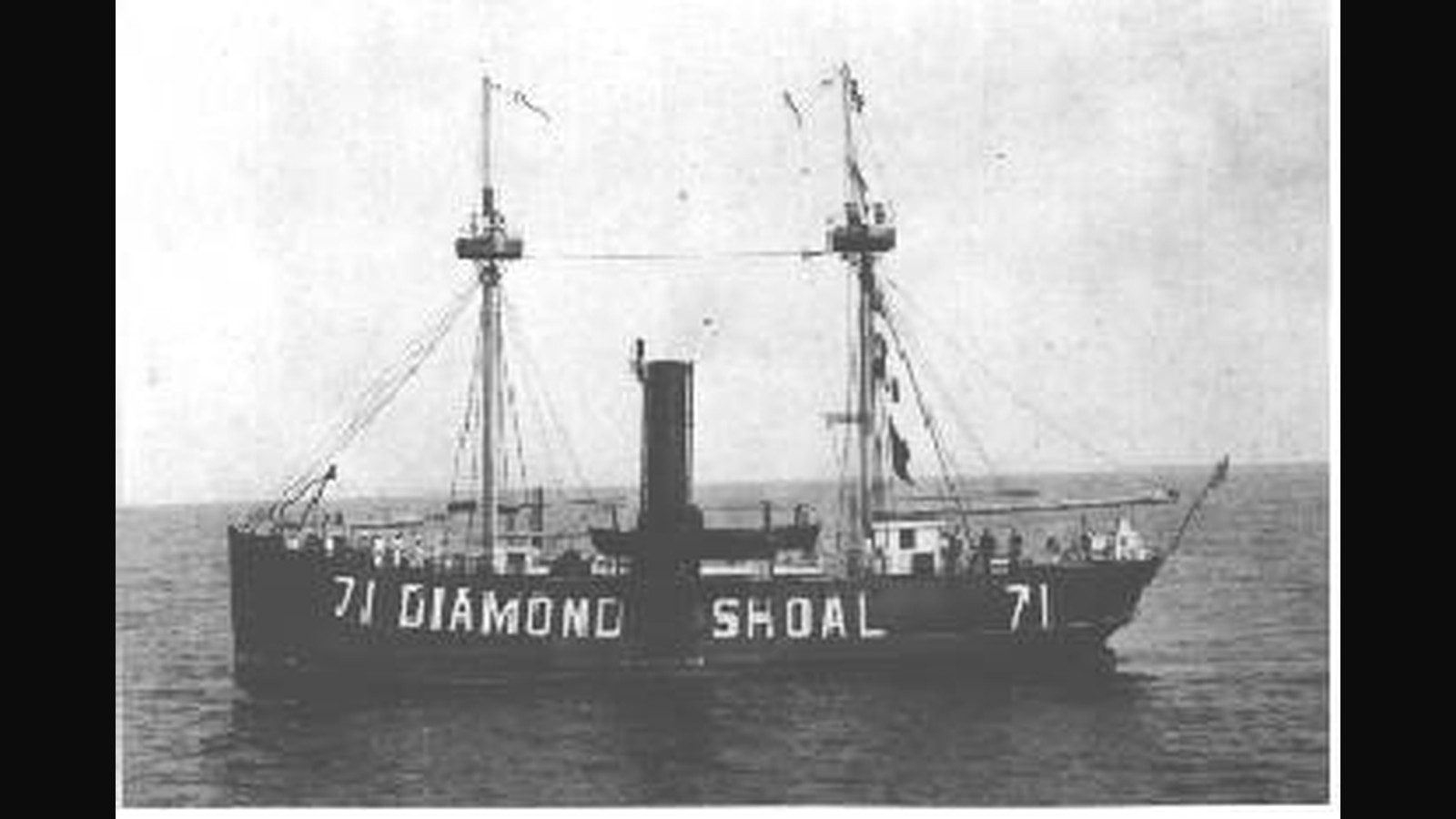
The National Park Service at Cape Hatteras National Seashore keeps the timeline. On January 29, 1921, the Deering, returning to Hampton Roads by way of Barbados, passed the Cape Lookout lightship. According to the lightship keeper, the crew was milling about, and a crewman "who did not look or act like an officer" called out that the ship had lost her anchors. The next day, at about 5:45 p.m., the steamer Lake Elon passed her southwest of the Diamond Shoals lightship, "steering a peculiar course."
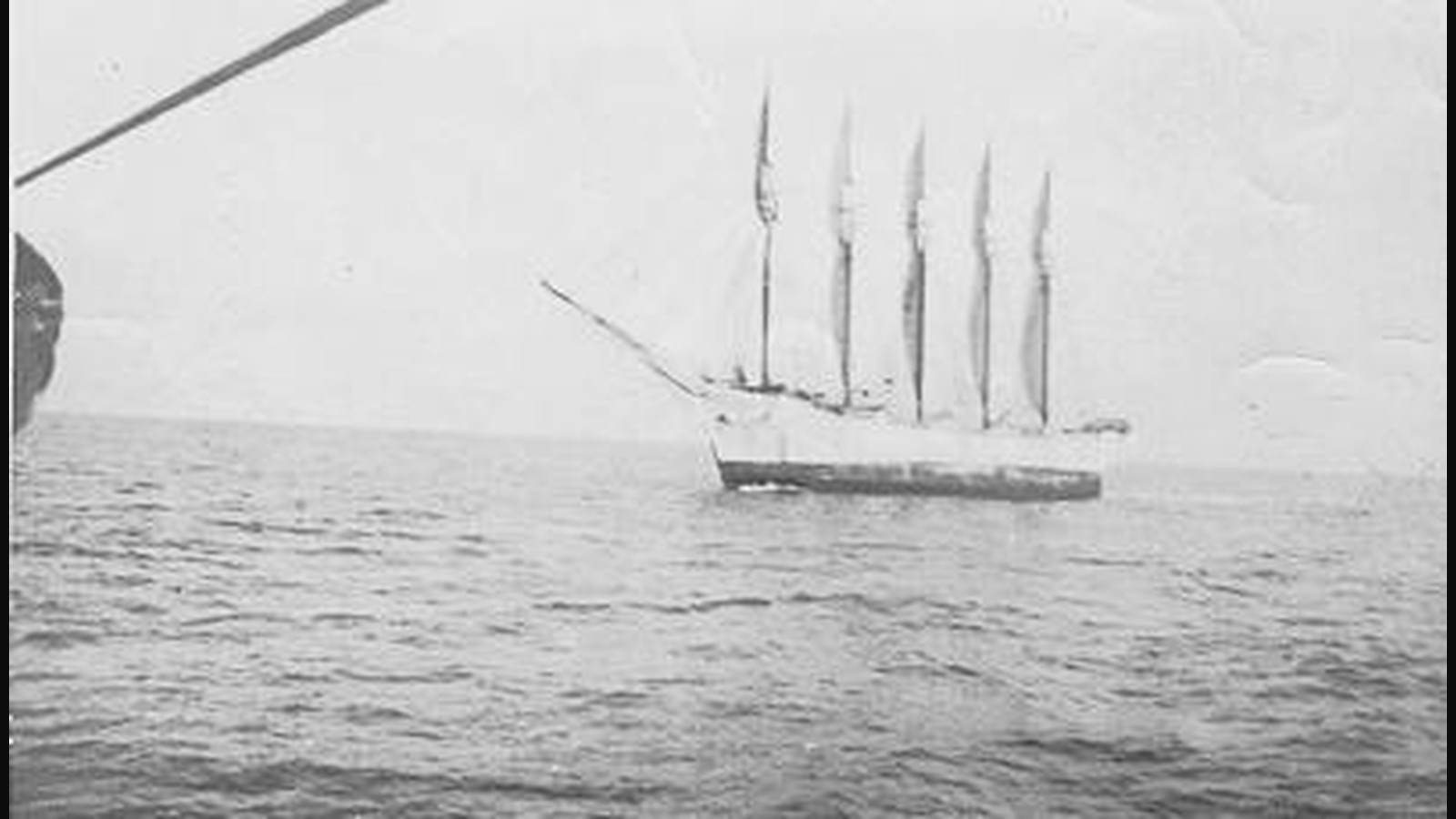
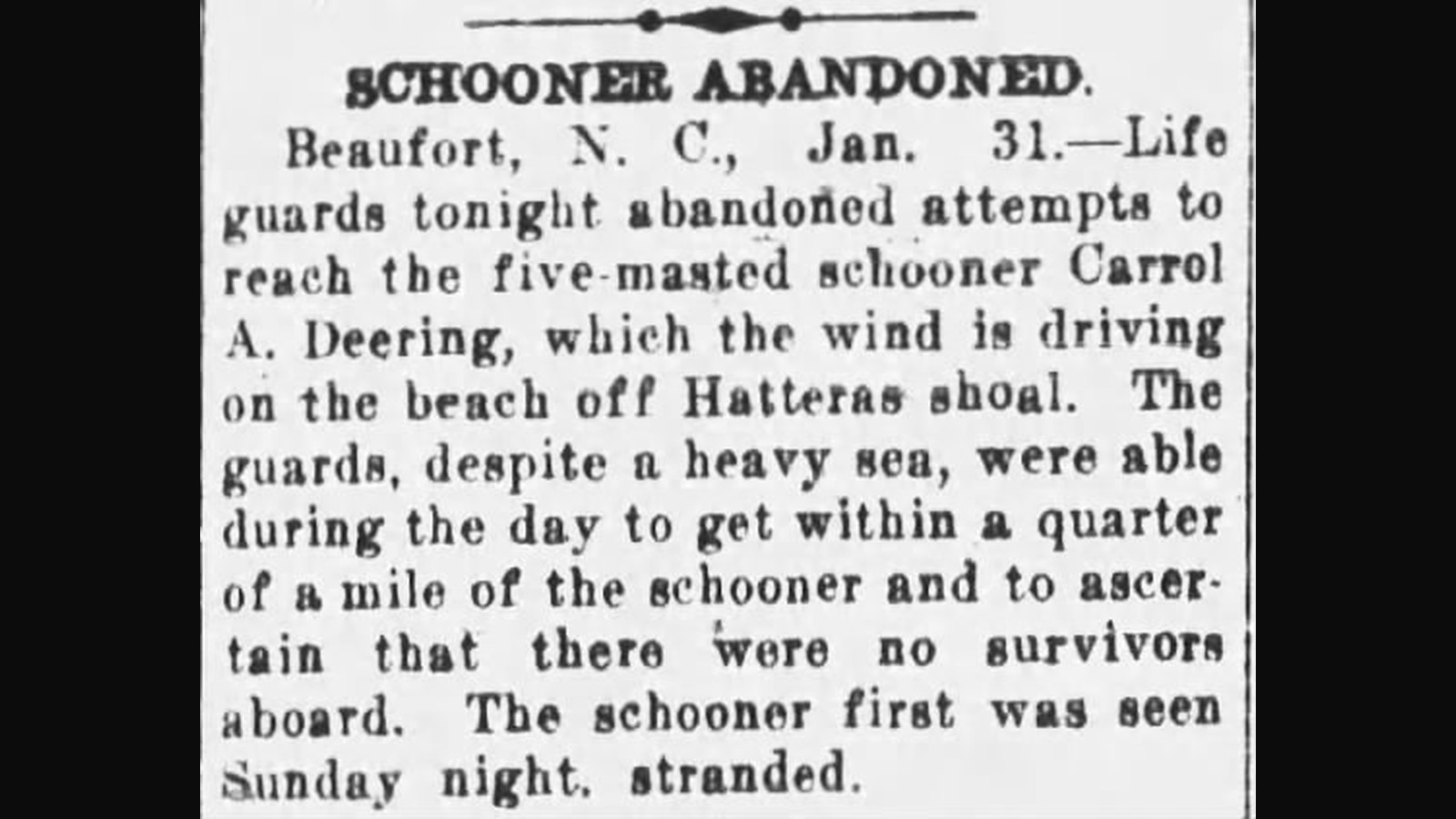
At 6:30 a.m. on January 31, C. P. Brady of the Cape Hatteras Coast Guard Station saw a five-masted schooner aground on the shoals, decks awash, sails set, lifeboats gone. Heavy seas kept the surf boats away. On the morning of February 4 the wrecker Rescue, with the cutter Manning, finally reached her, and Captain James Carlson went aboard. Personal belongings, key navigation equipment, certain papers and the anchors were missing. Food was laid out as if for a meal. There was no sign of the crew.
https://www.nps.gov/caha/learn/historyculture/theghostship.htm
Dinner on the stove
North Carolina's Department of Natural and Cultural Resources adds the ship's pedigree. She was built in 1919 by the G. G. Deering Company of Bath, Maine, one of the last of the great wooden schooners, and was coming home from a voyage to Brazil.
When the Coast Guard reached her, the state's account says, the crew, their navigation equipment, belongings, documents and lifeboats were gone, "but interestingly dinner was on the stove and the captain's cabin was a mess." A few months later the hulk was dynamited as a hazard. The case drew a visit to Dare County from the federal Bureau of Investigation. Explanations ranged from pirates and mutiny to the Bermuda Triangle. "The cause remains a mystery."
https://www.dncr.nc.gov/blog/2016/01/31/carroll-deering-ghost-ship
A note in a bottle
The Library of Congress's newspaper blog, Headlines and Heroes, follows the story through the 1921 press. In April, Christopher Columbus Gray of Buxton, North Carolina, reported finding a bottle on the shore with a note inside. "Deering captured by oil-burning boat," it read. The papers ran with it, and talk of a Bolshevik plot to seize American ships spread.
Not everyone in uniform agreed. Coast Guard Captain R. L. Gaskill, one of the first to sight the wreck, said "there is no mystery at all": stranded on the outer bar in 90 mph winds and mountainous seas, the crew had taken to the boats to try for shore nine miles away, and no boat could have survived. Captain Ballance of the Cape Hatteras station thought instead that the crew "abandoned her after taking everything of value, and ran her up on the Shoals intentionally." Those were two Coast Guard voices, and they did not agree. Washington had its own ideas.
Five departments and three cats
The Herbert Hoover Presidential Library, part of the National Archives, tells the federal side. When the ship was boarded, no one was aboard but three half-starved cats. The log and navigation equipment were gone, along with the crew's personal effects, the two main anchors, the motor boat and the dory. The captain's family pressed Washington for a full investigation, and five government departments looked into the case: State, Commerce, Treasury, Navy and Justice.
Commerce Secretary Herbert Hoover, whose department included the lighthouses, was worried that other ships had vanished in the same waters. His staff later found that most of them had sailed near a series of strong hurricanes, but the Deering had been sailing away from the storms. Hoover's aide Lawrence Richey ran the inquiry. Handwriting experts disagreed about the bottle note until Richey got Gray to confess that he had written it himself. In the end, "Richey and Hoover concluded that a mutiny was the most likely scenario, but kept the case open in case additional evidence was found."
https://hoover.blogs.archives.gov/2016/01/27/the-wreck-of-the-carroll-a-deering/
"Foul Play in Deering Case"
On June 22, 1921, the story reached the front page of The New York Times: "Foul Play in Deering Case: State Department Goes on Record as Suspecting It." The day before, the Commerce Department had added three more vessels to a list of disappearances it attributed to "circumstances more or less related to the supposed kidnapping of the crew" of the Deering.
The paper reported that officials did not claim every missing ship had fallen to "pirates or possibly Bolshevist sympathizers intending to dispose of ships and cargoes to the Government of Soviet Russia," but considered it significant that they had vanished about the same time. The list included the Spanish steamer Yute, the Russian bark Albyan and four ships lost in February, and "none of the ships added to the list today left any trace whatever." For believers, this is the heart of it. In June 1921, the word Washington used was kidnapping.
The file that survives
The investigation's paper trail still exists. The finding aid for the Lawrence Richey Papers at the Hoover Library lists Deering folders holding reports from the Bureau of Lighthouses, Commerce and Treasury, Bureau of Investigation reports from 1921 and FBI reports from 1956, correspondence, clippings and evidence, including five photographs.
No trace of the crew, the log or the instruments was ever found. A mutiny that left no survivors, a storm that left no boats, or men taken from a ship that sailed on without them: which story does the file really tell?
https://hoover.archives.gov/research/manuscript-collections/richey