
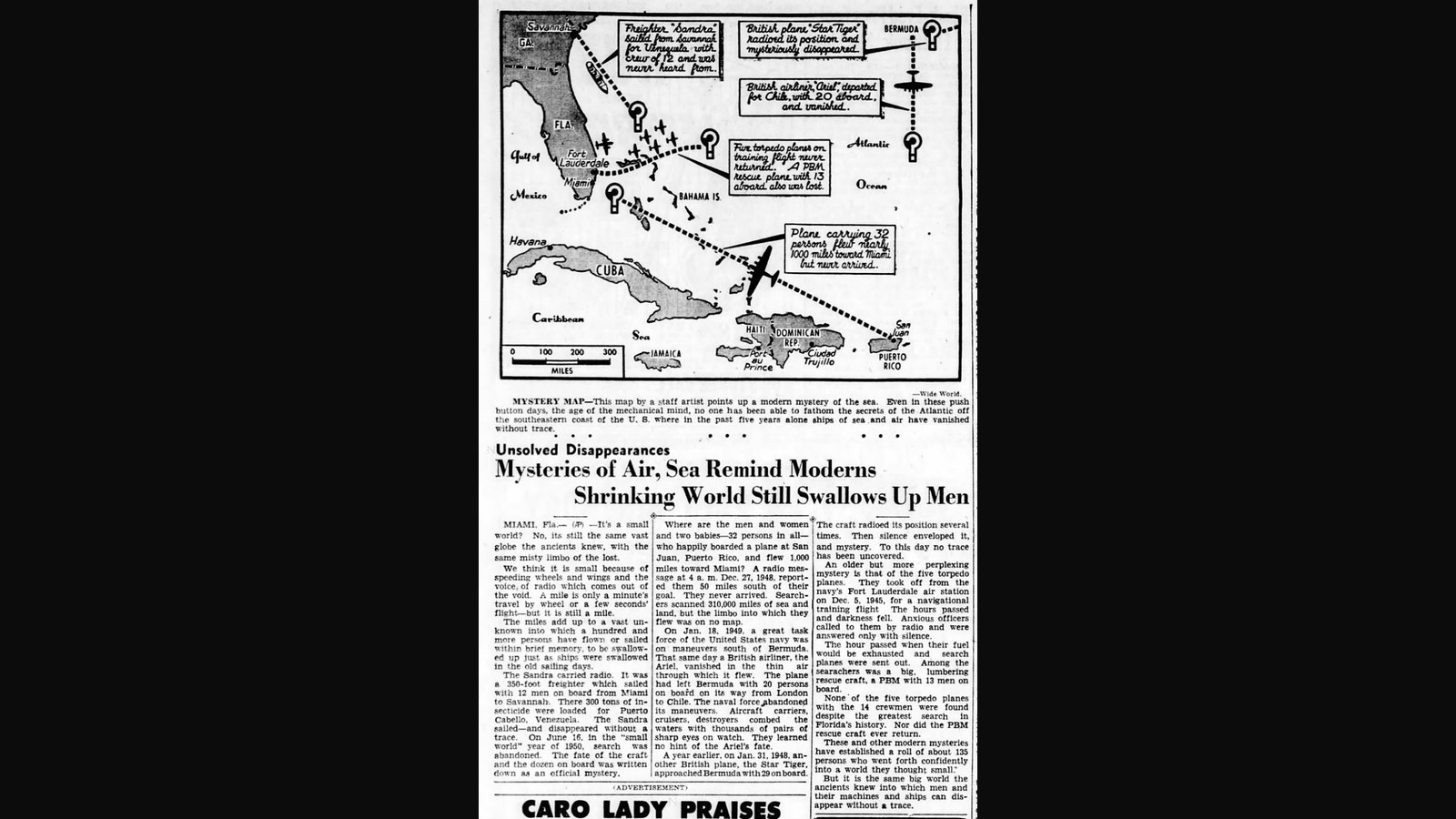
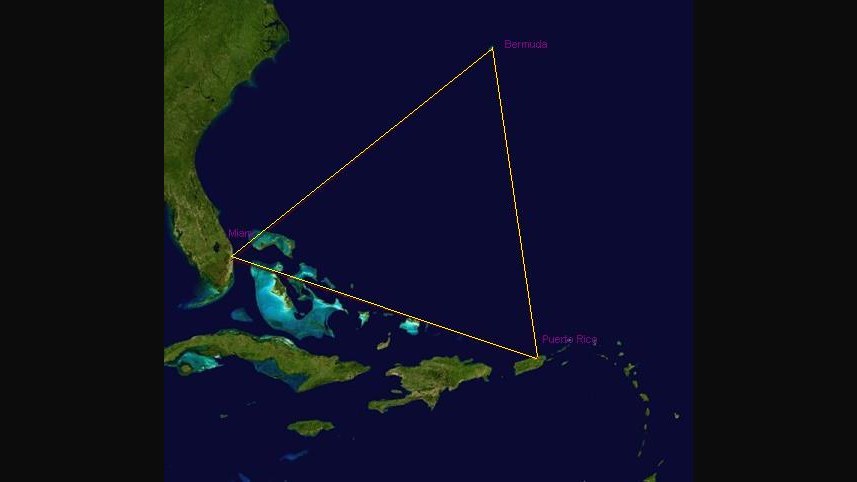
Some believe a stretch of the western North Atlantic, roughly between Florida, Bermuda and Puerto Rico, takes ships and aircraft and gives nothing back. No wreckage, no bodies, often no distress call. Adherents point to losses with the same signature: compasses that stop making sense, radio voices that sound lost, and craft that vanish in average weather. Explanations range from magnetic anomalies to forces nobody has yet identified. The ghost ship Carroll A. Deering, found in 1921, is often added to the list and has its own file.
"Both of my compasses are out"
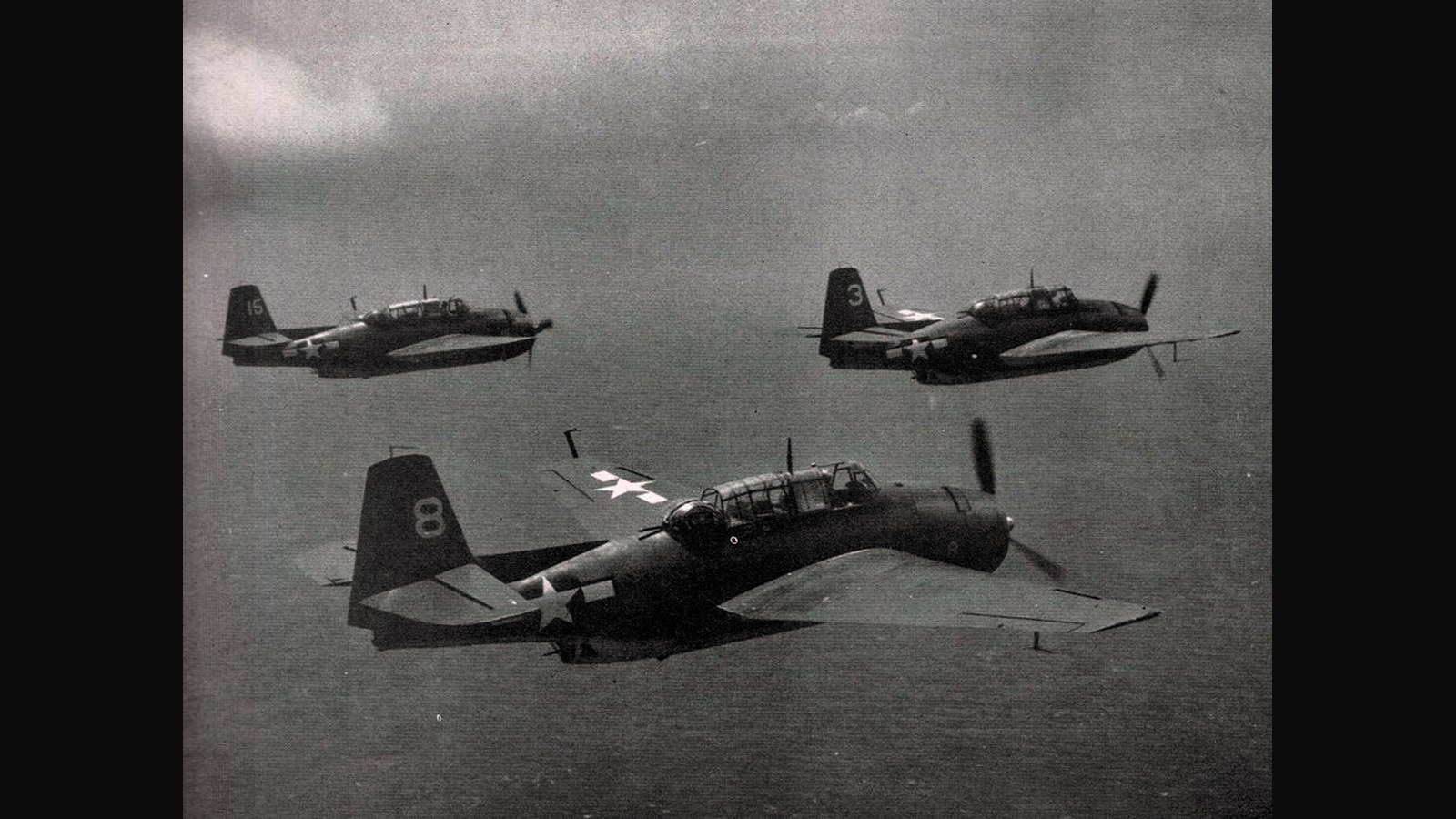
On December 5, 1945, five Navy Avenger aircraft left Naval Air Station Fort Lauderdale at 2:10 p.m. on a routine training flight, carrying 14 sailors and Marines. Archivists at the National Archives at Fort Worth, which holds part of the official record, have summarized what it shows. The leader, Lt. Charles C. Taylor, had combat experience and about 2,500 flight hours, 600 of them in Avengers.
At 3:40 p.m. one pilot radioed another: "I don't know where we are. We must have got lost after that last turn." Minutes later Taylor called the ground: "Both of my compasses are out, and I am trying to find Ft. Lauderdale, Florida... I am sure I am in the Keys." He was in fact well northeast of base. For two hours the flight changed direction as the pilots argued over which way was home. The last transmission monitored, at 7:04 p.m., was Taylor telling the others that "when the first plane drops below ten gallons, we all go down together." The official account, as the archivists summarize it, is that the flight got lost through pilot error, with Taylor "uncertain as to in what position lay the Peninsula of Florida."
Six aircraft, 27 men
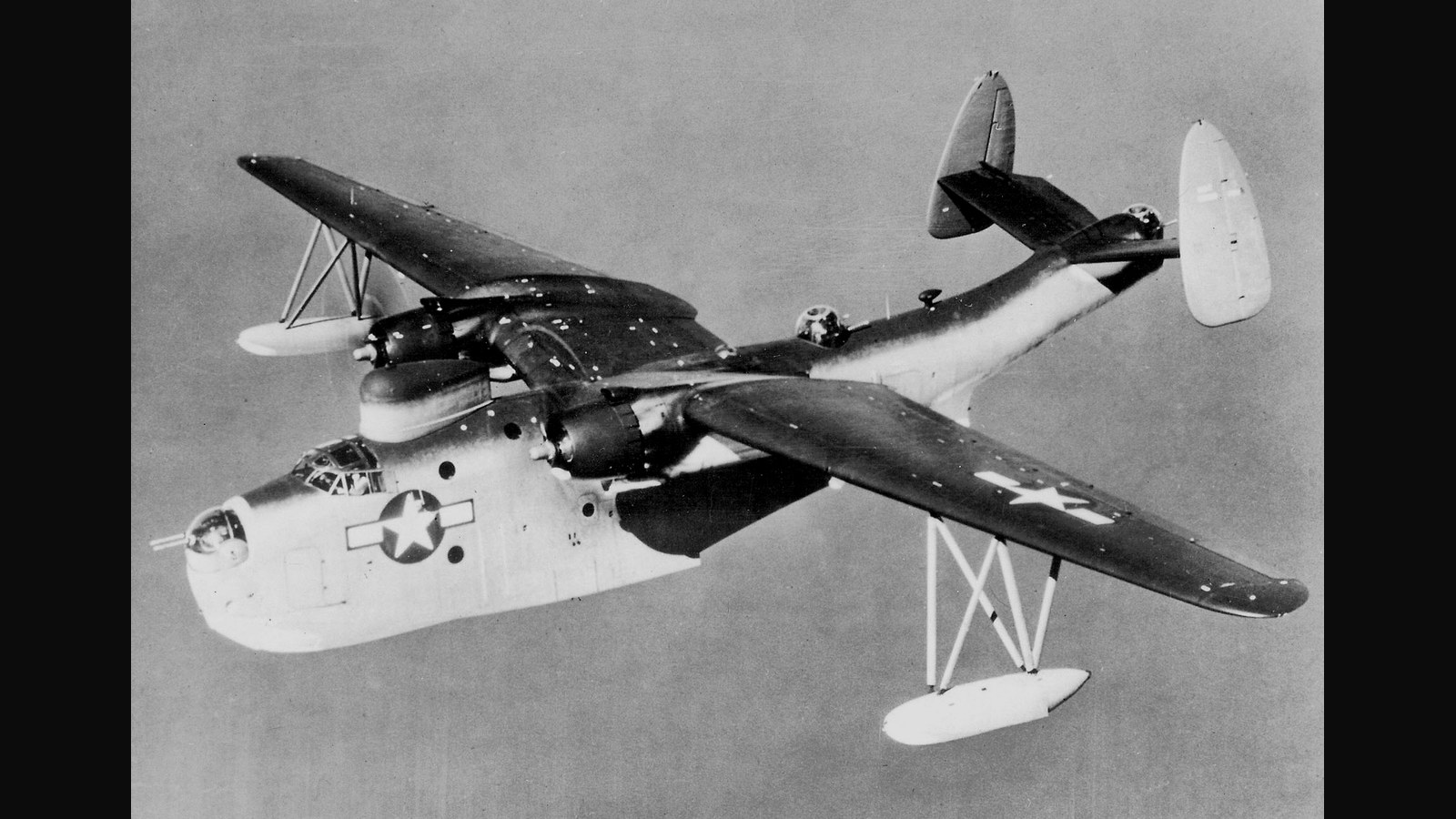
The Navy's Board of Investigation, convened at NAS Jacksonville on December 7, 1945, laid out the night minute by minute. Fort Lauderdale learned at 4:11 p.m. that the leader's plane, FT-28, was uncertain of its position, and the Board recorded that the aircraft were "experiencing malfunction of their compasses." As darkness fell, a Martin PBM-5 Mariner flying boat, Bureau Number 59225, left NAS Banana River at about 7:27 p.m. to join the search. The official accident cards, transcribed by the Navy Department Library with crew lists for every aircraft, read like a roll call: five Avengers and 14 men, one Mariner and 13 men.
Two findings are the ones believers return to. The tanker SS Gaines Mills reported flames "100 feet high" and a pool of oil at 28°59'N, 80°25'W, and aboard the carrier USS Solomons a radar contact disappeared at that same spot. The Navy's view was that the Mariner exploded in the air, and it attributed the loss to a faulty fuel system. Adherents point to the same flames and vanishing blip, and to what was never found. The search ran from December 6 to 10, and no wreckage, raft or body from any of the six aircraft was ever recovered.
https://www.ibiblio.org/hyperwar/USN/rep/Flight19/index.html https://www.history.navy.mil/research/library/online-reading-room/title-list-alphabetically/l/loss-of-flight-19-official-accident-reports.html
A collier that never sent a word
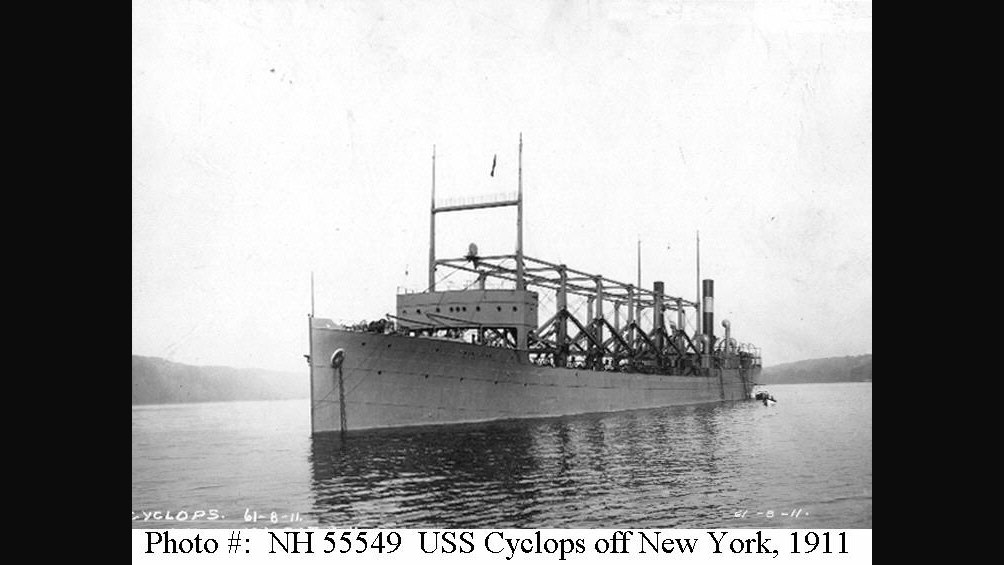
Twenty-seven years earlier, the same waters had taken a Navy ship. USS Cyclops was a 542-foot collier, launched in 1910 by William Cramp and Sons in Philadelphia to carry coal to the fleet. She was commissioned on May 1, 1917, after the United States entered the First World War, with Lt. Cmdr. George W. Worley in command.
In early 1918 she was sent to Brazilian waters to fuel British ships. She put to sea from Rio de Janeiro on February 16, 1918, touched at Barbados on March 3 and 4, and was never heard from again. Accounts differ on how many people were aboard. The Navy's Dictionary of American Naval Fighting Ships offers no cause. It says only: "Her loss without a trace is one of the sea's unsolved mysteries."
The captain and the sisters
In March 2018 the Director of the Naval History and Heritage Command, Samuel J. Cox, returned to the case. The early theories were mutiny and sabotage, he writes, and they began with the captain. Worley had been born Johann Frederick Wichmann in Germany, and many of his crew called him the "damned Dutchman." The Office of Naval Intelligence found no evidence he was disloyal and no evidence the crew had seriously contemplated mutiny, though rumors passed on by the U.S. consul in Barbados pointed to what the Director calls a "toxic command climate."
The official account he gives is structural: a ship designed for coal, carrying heavier ore, may have found a weakness in her design. Then comes the detail that keeps the file open for believers. Two of her three sister ships, Proteus and Nereus, both sold to Canadian owners in 1941, also vanished without a trace in the same waters, Proteus after November 23 with a crew of 58 and Nereus after December 10, both carrying bauxite ore. Neither loss, the Director notes, was the work of German submarines.
Marine Sulphur Queen
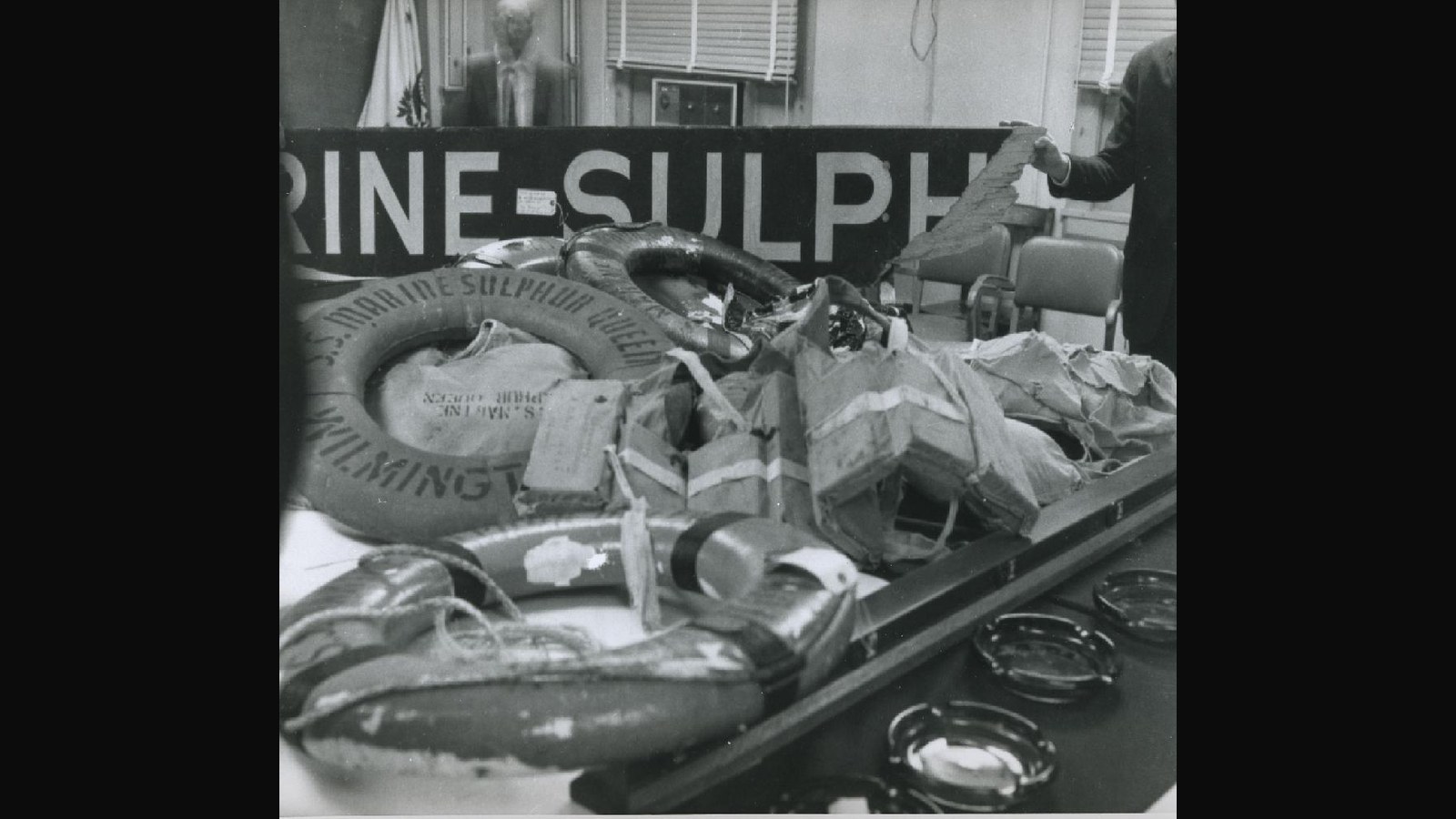
On February 2, 1963, the SS Marine Sulphur Queen left Beaumont, Texas, for Norfolk, Virginia, with 15,260 tons of molten sulphur and 39 men. She was last heard from at 1:25 a.m. on February 4. Military aircraft flew 83 flights over 348,400 square miles and found nothing. On February 20 a Navy vessel picked up a life preserver and a fog horn stenciled with the ship's name, 12 miles southwest of Key West. The hull was never found.
The Coast Guard Commandant's Action of March 17, 1964 sets out the official account: heavy weather, a long history of fires in sulphur-soaked insulation, and structural questions from her conversion. Like the others, it was written without a wreck to examine. Six aircraft, four ships, and every soul aboard. Was it weather, structure and human error each time, or is something in these waters still unaccounted for?
https://web.archive.org/web/20080509103209/http://home.pacbell.net/corwind/cgreport.html