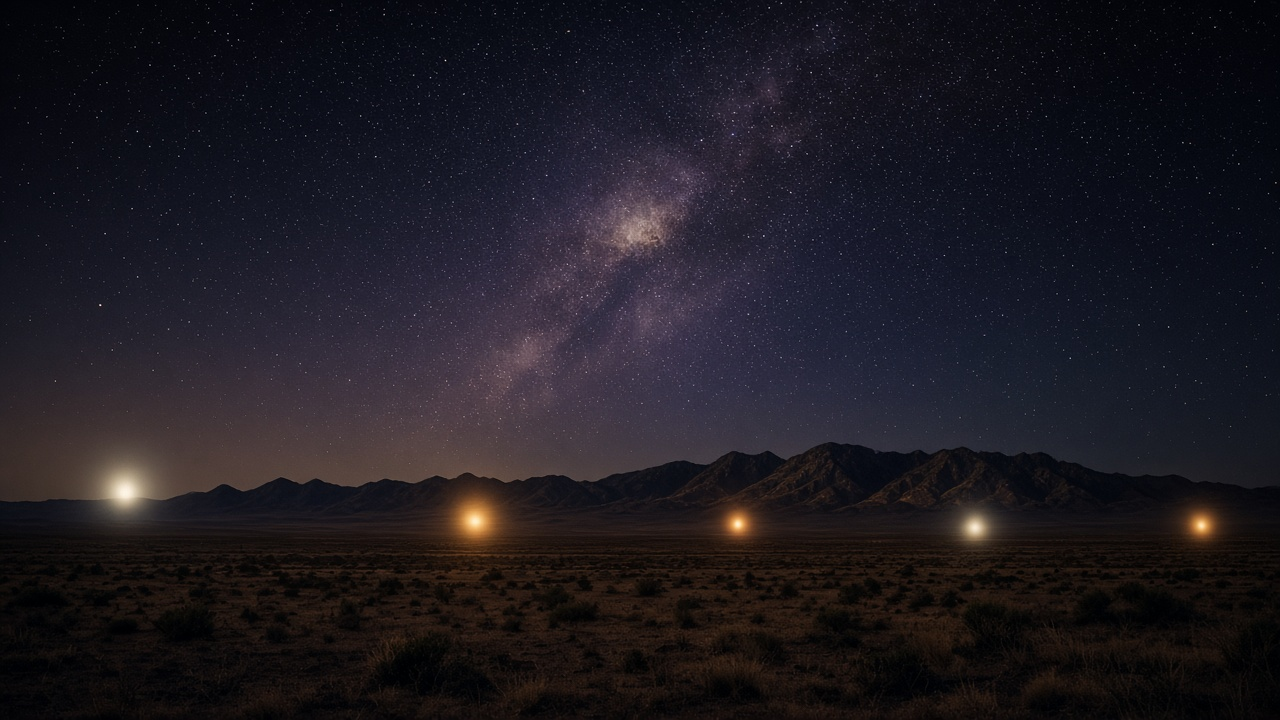
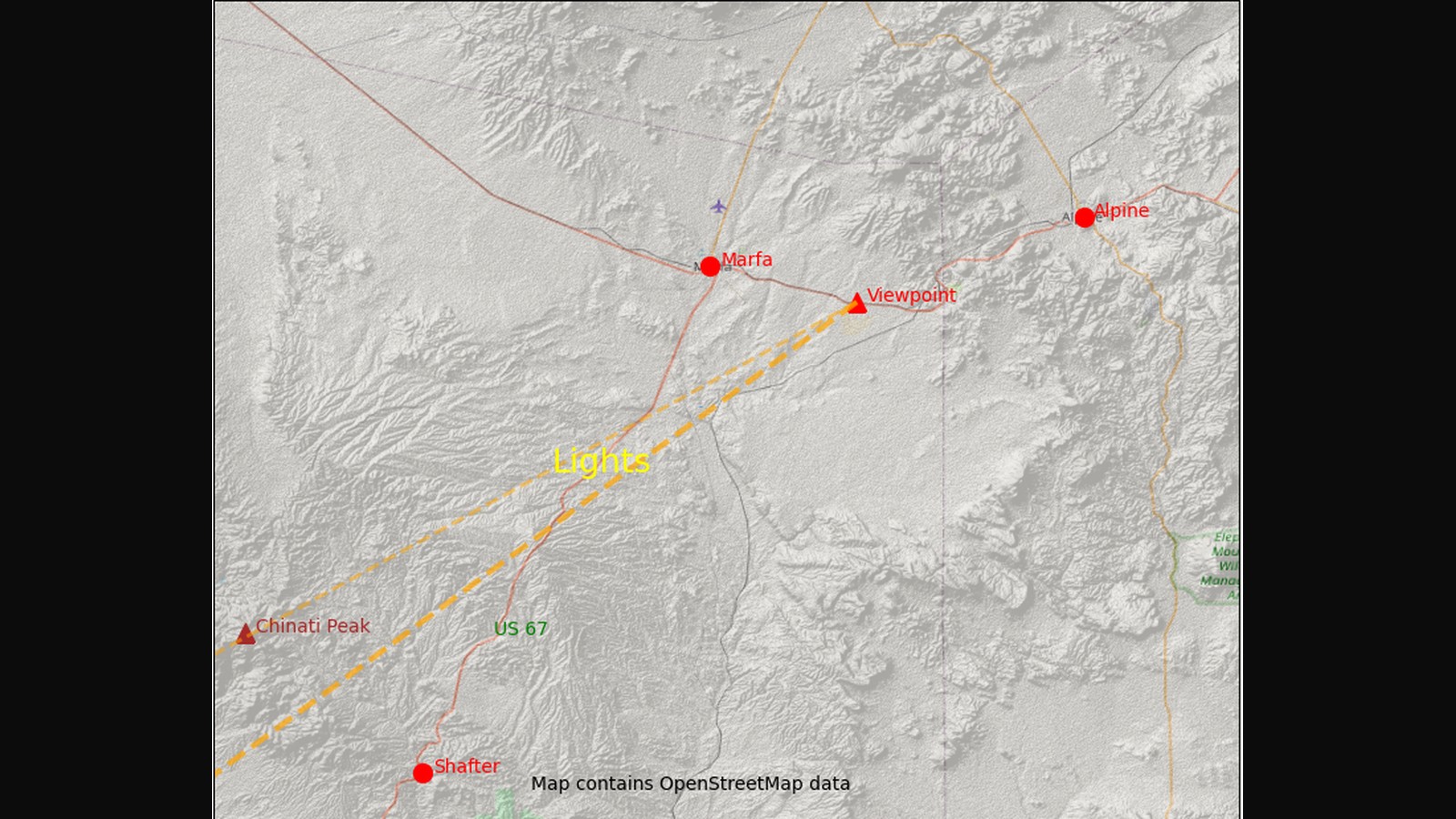
Some believe the lights that appear on clear nights over Mitchell Flat, east of Marfa, Texas, are a genuine unexplained phenomenon. Observers facing the Chinati Mountains describe lights that twinkle, split apart, melt together, disappear and come back. Adherents point out that settlers reported them before there were cars on the road, that they retreat when approached, and that searches on horseback, from the air and with automated cameras have not pinned down what all of them are. Theories run from electrical charges in the rock underfoot to ghosts.
A cowhand in Paisano Pass
The Handbook of Texas, published by the Texas State Historical Association, gives the record. The lights are often visible between Marfa and Paisano Pass in northeastern Presidio County, and residents have watched them for more than a hundred years. The first historical record comes from 1883, when a young cowhand named Robert Reed Ellison, driving cattle through Paisano Pass, saw a flickering light and wondered if it was an Apache campfire. Other settlers told him they often saw the lights, "but when they investigated they found no ashes or other evidence of a campsite." Joe and Sally Humphreys reported their first sighting in 1885.
In the summer of 1919 cowboys rode over the mountains looking for the source and found nothing. Observers in the First World War feared the lights were meant to guide an invasion, and in the Second World War, pilots training in the region searched for them from the air, "again with no success." Mrs. W. T. Giddings, who grew up watching them, said her father was saved in a blizzard when the lights led him to the shelter of a cave. The Handbook's own view is that the most plausible explanation is a mirage-like effect, where layers of cold and warm air bend distant light. No agency has ruled on the lights.
https://www.tshaonline.org/handbook/entries/marfa-lights
A Cyclopean eye
The earliest magazine account found is Paul Moran's "The Mystery of the Texas Ghost Light," in Coronet for July 1957. "Settlers first reported it more than 70 years ago," he wrote. "Yet to this day, no one knows what it is, where it originates, or why it shines." He describes a "weird Cyclopean eye" in the Chinatis. "Approached from the air, or over the 50 miles of sun-seared terrain," he wrote, "it suddenly vanishes."
Moran also made the point believers still lead with. Seventy years before his article, "the brightest light in this area was a kerosene lantern." Whatever the settlers saw, it was not a highway.
https://archive.org/details/sim_coronet_1957-07_42_3
The students and the chase car
A team of about a dozen students from the University of Texas at Dallas chapter of the Society of Physics Students took the question into the field. Their progress report describes cameras set up at the official viewing area, counts of traffic on a nearby highway, and a chase car sent out to test line of sight. Every light they saw from the viewing area fell along the line of sight toward a radio tower.
Their conclusion was that "all the lights reliably observed during the experiment were car headlights." That is the study most often given as the answer. For adherents, its limit is plain: it describes what the students reliably saw on the nights they watched, and it does not account for the sightings of the 1880s, when no headlights existed.
https://web.archive.org/web/20070620170535/http://www.spsnational.org/wormhole/utd_sps_report.pdf
Three percent
James Bunnell, a retired aerospace engineer who grew up in Marfa, spent eight years, from 2001 to 2009, watching with instruments. According to a Foreword Reviews (Clarion) review of his book Hunting Marfa Lights, he installed three monitoring stations with nine cameras to record nightly video, and compiled the accounts of 34 people who had encountered the lights.
His conclusion is the heart of the modern case. Most of the lights, he found, have a plausible explanation. About three percent, in his assessment, do not. The reviewer calls his research methods sound and his book "a scholarly evaluation." For believers, three percent of a century of sightings is a great many unexplained lights.
https://www.forewordreviews.com/reviews/hunting-marfa-lights/
Rock, charge and fallen stars
Live Science's overview of the lights sets out the competing ideas. Bunnell proposes that the igneous rock beneath Mitchell Flat generates a piezoelectric charge that powers the lights. Native Americans of the area, according to the Houston Chronicle as quoted by Live Science, thought the lights were fallen stars.
Engineering professor Karl Stephan of Texas State University, who has studied the lights with spectroscopy, has considered the geological idea without endorsing it. "It may be geological activity that creates electrical activity," he told Live Science, "but it's all speculation at this point." On the record, that is still where the science stands.
https://www.livescience.com/37579-what-are-marfa-lights-texas.html
"A mystery to be reckoned with"
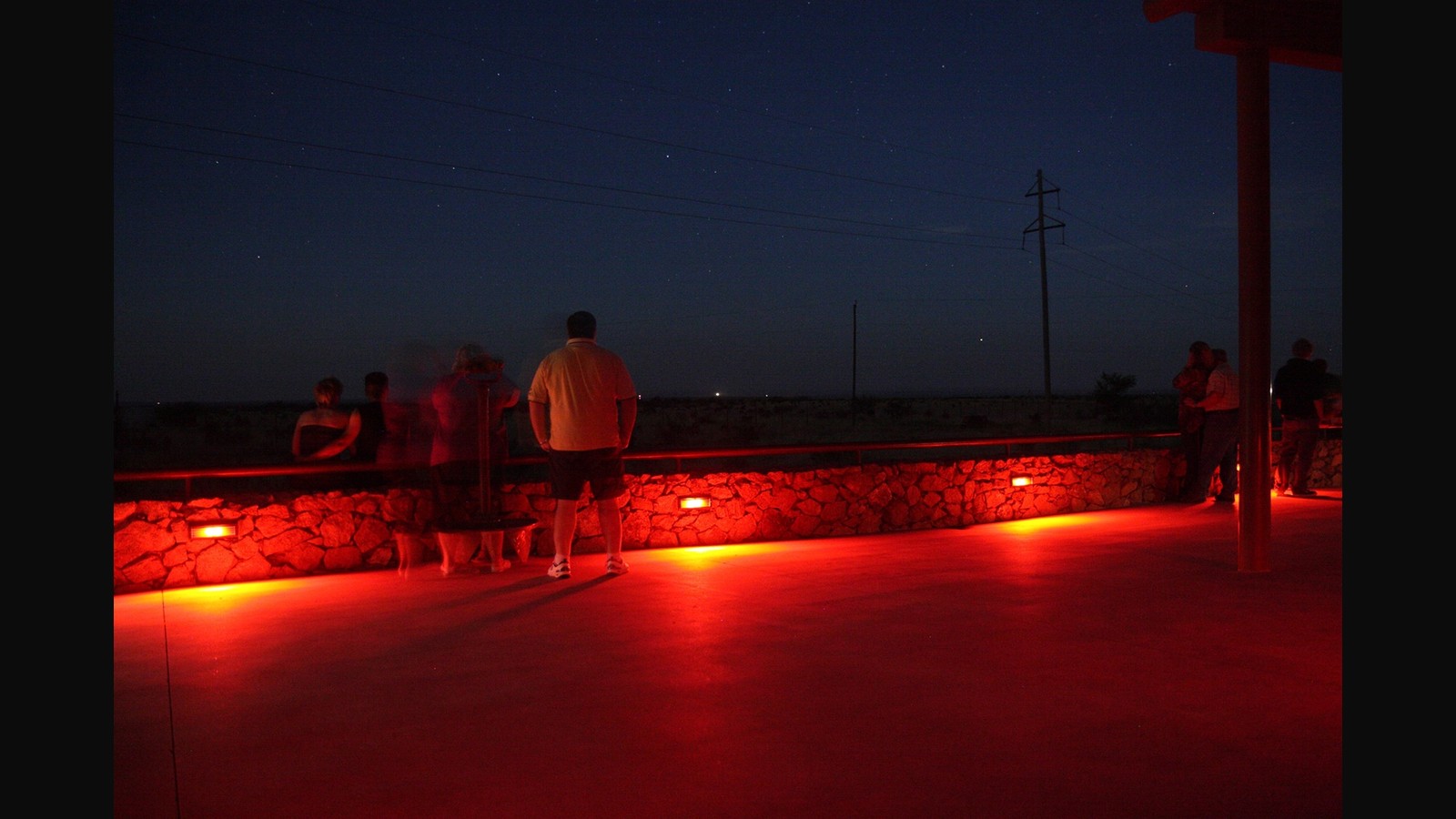
Marfa has made its peace with the mystery. The town's official visitor site calls the lights "a mystery to be reckoned with," hosts an annual Marfa Lights Festival, and directs visitors to the official viewing area east of town, where the Marfa Mystery Lights Viewing Center has stood since 2003.
More than 140 years after a cowhand looked for ashes and found none, people still stand at that roadside platform after dark and watch the horizon. Headlights, mirage, charged rock or something no one has named: what is out there over Mitchell Flat?