
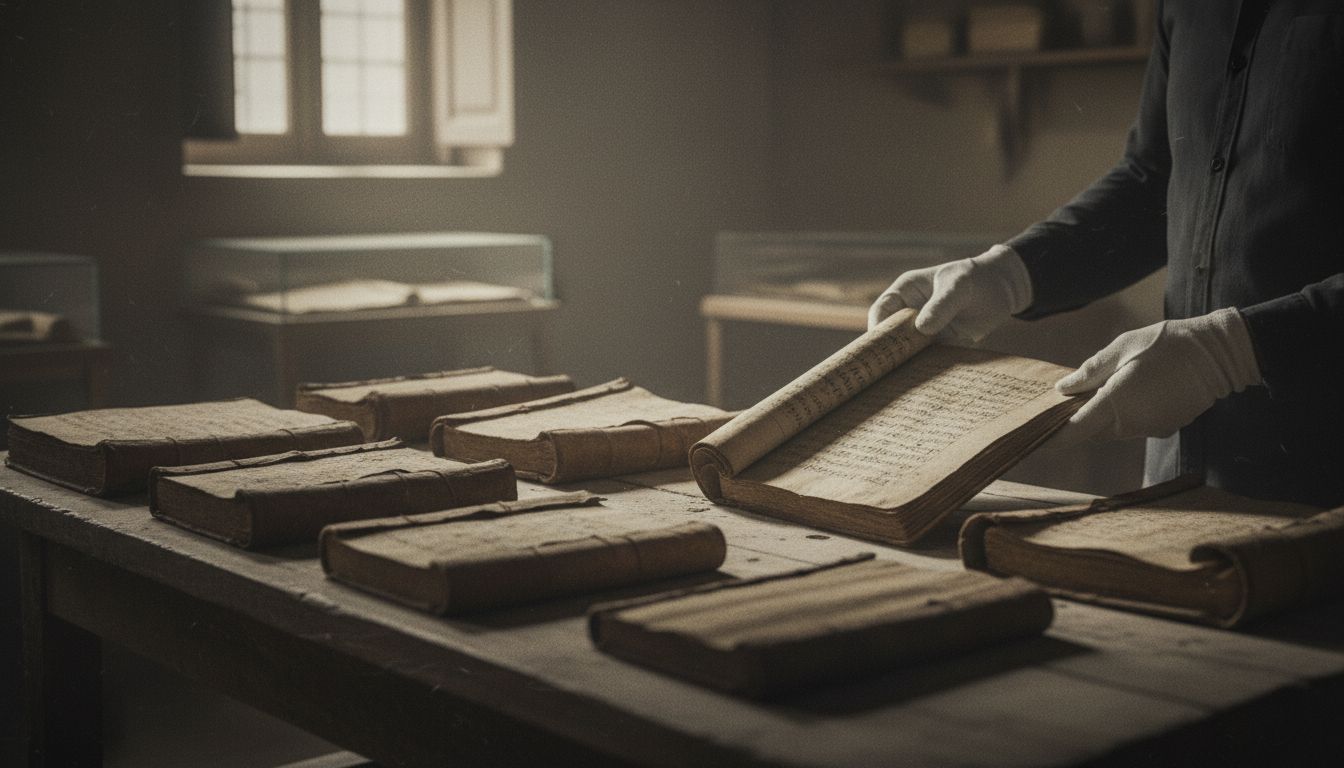
In 1945, according to the standard find narrative, farmers near Nag Hammadi in Upper Egypt recovered a sealed ceramic jar containing papyrus books. The thirteen codices that entered scholarly and museum history—mostly Coptic translations of Greek religious and philosophical texts—became the Nag Hammadi library, the densest surviving first-hand dossier for what modern scholarship calls Gnosticism. The bulk of the collection sits today in the Coptic Museum in Cairo. This Archive file is documented. The shelf tension is not whether the books exist. It is custody: find-story gaps, foreign sojourns, facsimile politics, and who controlled publication clocks.
The Find Narrative and Its Gaps
The usual telling places the discovery at the foot of the Jabal al-Tarif cliff near Hamrah Dum, across the Nile from Nag Hammadi. A jar. Books in Coptic. A chain of local sales and intermediaries before museum accession. Claremont’s Coptic Encyclopedia article on the Nag Hammadi Library is frank that details remain unverified despite later archaeological investigation, and that some scholars suspect illicit grave excavation rather than a clean accidental find. Documentary filing keeps that uncertainty visible. A famous discovery story is not the same object as a fully instrumented dig diary.
Claremont Coptic Encyclopedia — Nag Hammadi Library: https://ccdl.claremont.edu/digital/collection/cce/id/1418.
What the Library Holds
The codices are books, not a single gospel. Tractates include works that entered public fame—above all the Gospel of Thomas—alongside many others that reshaped how historians talk about early Christian diversity, Sethian and Valentinian currents, and late antique philosophy in Egypt. Standard numeration follows the ARE–UNESCO Facsimile Edition tradition. The material fact is papyrus, leather covers, Coptic script, museum numbers. The cultural fact is that texts once treated as destroyed or only known through hostile quotations returned as primary manuscripts.
Egypt’s museums portal situates the Coptic Museum inside a national antiquities museum ecosystem even when English-language scholarship routes through Claremont photography and encyclopedia articles.
Egypt monuments museums portal: https://egymonuments.gov.eg/en/museums.
Jung Codex and Foreign Custody
Part of Codex I left Egypt and became known as the Jung Codex while in the orbit of C. G. Jung’s heirs and European scholarship. Return to Cairo rejoined that portion to the Coptic Museum collection. The Claremont Coptic Encyclopedia’s Codex Jung entry is the compact institutional door for that exit-and-return drama. Custody fights are not folklore bolted onto an innocent dig. They are part of how the library became globally famous: fragments abroad, negotiations home, photographs standing in for brittle pages.
Claremont CCE — Codex Jung: https://ccdl.claremont.edu/digital/collection/cce/id/486/.
Photography, Facsimile, Publication Clocks
The Claremont Colleges Digital Library’s Nag Hammadi Archive preserves excavation-environment images, conservation work, visiting dignitaries, and scholar labor from the Institute for Antiquity and Christianity project. Later visitors meet illegible or fragile openings; mid-1970s photography and the UNESCO-linked Facsimile Edition became how many pages could still be read. Publication control—who edited, who delayed, who released English translations—generated its own controversies, sibling to Dead Sea Scrolls fights over access. Documented filing centers those institutional clocks rather than a conspiracy sermon about orthodoxy’s monopoly.
Nag Hammadi Archive: https://ccdl.claremont.edu/digital/collection/nha/.
Archive search door: https://ccdl.claremont.edu/digital/collection/nha/search.
Claremont Coptic Encyclopedia home: https://ccdl.claremont.edu/digital/collection/cce/.
Why Documented Still Has Teeth
Settled on the packets: a major Coptic manuscript library associated with the Nag Hammadi region entered modern knowledge after 1945; most codices are in the Coptic Museum; Jung Codex portions traveled and returned; Claremont and UNESCO-era facsimile/publication projects created the research infrastructure still used today. Overclaim to refuse: a single cinematic farmer-hero dig with no gaps; a claim that the library “disproves” institutional Christianity as a courtroom verdict rather than supplying contested late-antique texts for historical debate.
The Archive tension is provenance and control. Readers who want only mystical revelation will skim the museum numbers. Readers who want only scandal will miss why the facsimile committee and photographic archive matter. The file holds find narrative, accession, foreign custody, and edition history on one page.
Archive Siblings
Dead Sea Scrolls publication controversies are the nearest manuscript-access sibling. Other Coptic magical and monastic text corpora sit nearby without collapsing into one “suppressed gospel” megastack. Keep Nag Hammadi on the Coptic Museum and Claremont spine.
Custody Is the Plot
Viral religion media often treats Nag Hammadi as a pure revelation event: jar opens, secret words return, churches tremble. Museum and encyclopedia paperwork treat it as a custody chain: sale paths, accession numbers, acrylic mounting, committee editions, photographs when ink fails. Both stories use the same codices. Only one of them fits documented filing. The revelation story is reception. The custody chain is the file’s spine.
What the Paper Trail Settles
Settled: thirteen codices; Coptic Museum core holding; Jung Codex return; Claremont photographic and encyclopedia infrastructure; lasting impact on early Christian and Gnostic studies. Still debated in ordinary scholarship: exact findspot circumstances; ownership before museum deposit; how to periodize and label every tractate’s community. Those debates do not erase the library.
The tension that remains is institutional. Officials and scholars present a conserved manuscript collection with a messy twentieth-century biography. Popular captions present a suppressed scripture vault cracked open by accident. Nag Hammadi is that biography—read with the Claremont archive and Coptic Encyclopedia open, and with conspiracy captions left labeled as claim.