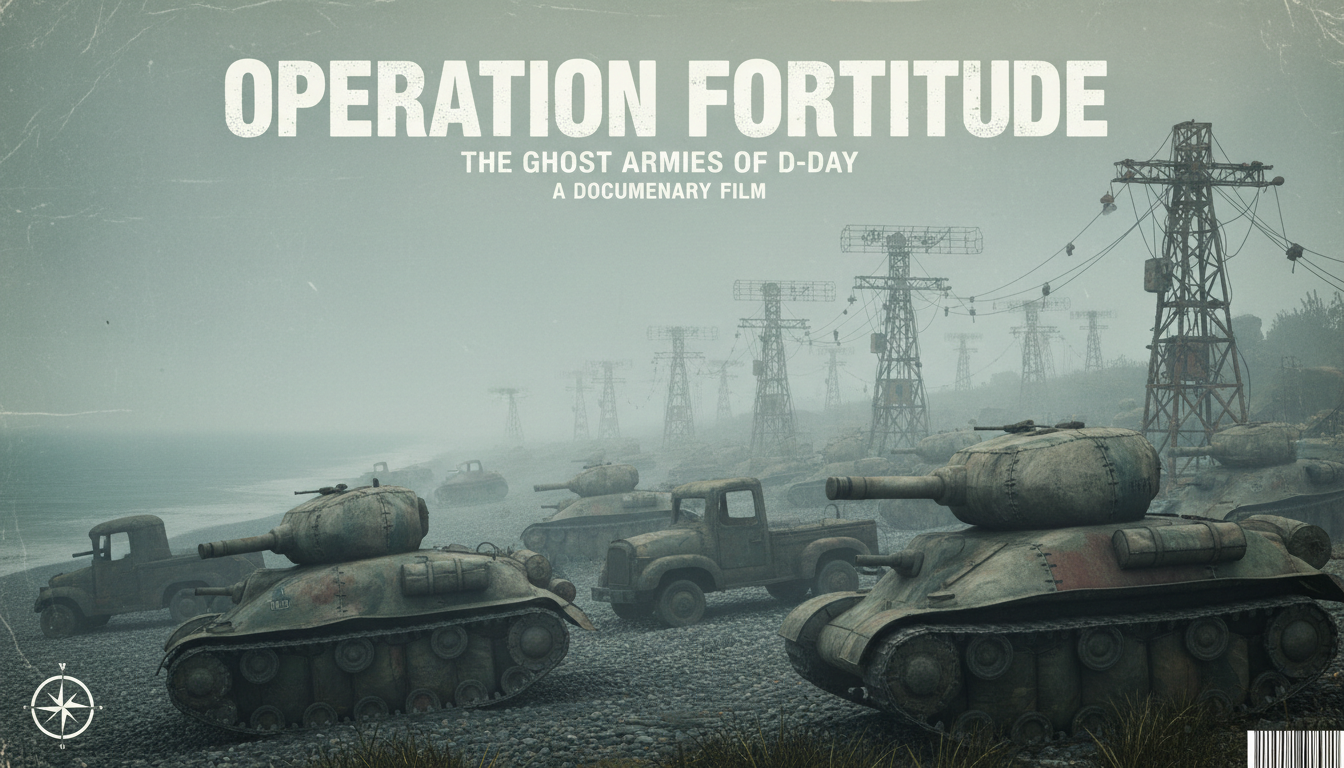
By the time Allied forces crossed the Channel on 6 June 1944, German commanders were already living inside a story written for them. Operation Bodyguard—the strategic deception frame for OVERLORD—and its Fortitude components tried to pin German attention on the Pas-de-Calais and on threats to Norway while the real weight landed in Normandy. The Double-Cross System, run through MI5’s B1A and the Twenty Committee, supplied a second spine: captured or turned German agents whose wireless channels carried controlled traffic. The Archive so-what is documentary. UK National Archives KV files, MI5’s own history pages, SHAEF/Bodyguard primaries, and CIA Studies in Intelligence essays on Masterman still open. Folklore that turns every Wehrmacht mistake into a British puppet show does not.
Bodyguard and Fortitude
London Controlling Section planning under John Bevan produced cover concepts for OVERLORD that evolved into Bodyguard after the Tehran Conference settled the cross-Channel timing politically. Fortitude split the threat story: Fortitude North aimed at Scandinavian fears; Fortitude South aimed at the Pas-de-Calais and the ghost of a First United States Army Group waiting to jump after a “diversion” in Normandy. Physical deception—dummy landing craft, inflatable armor, spoof radio nets—shared the stage with agent traffic. Eisenhower Foundation’s Bodyguard primary-source library keeps the planning door where readers can start without a secondary novelization.
Eisenhower Foundation — War Cabinet Plan BODYGUARD: https://eisenhowerfoundation.net/primary-source-library/war-cabinet-plan-bodyguard/
The Double-Cross Machine
MI5’s wartime history states the mechanism without romance: enemy agents in Britain were uncovered; some were turned; the resulting Double-Cross system fed false military information to Germany and contributed to Normandy’s success. J.C. Masterman’s 1945 report on B1A special agents—held as KV 4/5 at The National Archives—became the internal after-action spine later published and endlessly argued. The Twenty Committee’s job was not to invent infinite spies. It was to decide which truths could be spent, which lies would survive checking, and which channels were still believed in Berlin and Madrid.
The National Archives — KV 4/5 Masterman report: https://discovery.nationalarchives.gov.uk/details/r/C3539650
MI5 — World War II history: https://www.mi5.gov.uk/history/world-war-ii
GARBO and the Calais Story
Juan Pujol García—MI5 case name GARBO—built a fabricated agent network the Abwehr trusted. KV 2/4200 and related volumes document the progressive development of that network and of schemes to convey disinformation, including traffic relevant to D-Day deception. MI5’s Agent GARBO page keeps the official Service summary: a channel used for strategic deception around the invasion. After the landings, contingency planning worried about Abwehr defections blowing the network—bureaucracy meeting tradecraft, not a film ending.
The National Archives — KV 2/4200 GARBO: https://discovery.nationalarchives.gov.uk/details/r/C16282441
MI5 — Agent GARBO: https://www.mi5.gov.uk/history/world-war-ii/agent-garbo
Official Posture: Contribution, Not Omniscience
Allied deception officers and later historians argue about weights: how much Fortitude moved divisions, how much Ultra and air interdiction and German rigidity did the rest. That debate is healthy. What the primary doors will not support is the slogan that Double-Cross “controlled Hitler.” Controlled agents influenced German appreciation; they did not rewrite German logistics, politics, or every field commander’s will. CIA’s Masterman Revisited essay is useful precisely because it treats Masterman’s book as a historical artifact to be assessed, not as scripture.
CIA CSI — Masterman Revisited: https://www.cia.gov/resources/csi/static/Masterman-Revisited.pdf
Why the Two Spines Belong Together
Fortitude without Double-Cross is mostly theaters and radio spoof. Double-Cross without Fortitude is clever traffic without a strategic destination. The wartime so-what fused them: physical and wireless lies aimed at the same German planning assumption—that Normandy was a feint and Calais the main blow—long enough for lodgment. Readers who isolate “the spy” or “the inflatable tank” miss the committee work that synchronized both.
Date discipline keeps the romance down. Bodyguard planning crystallizes in late 1943; Fortitude runs through the invasion summer; Masterman’s report is a 1945 stocktaking; public KV releases arrive decades later in tranches. Continuity of myth is not continuity of file. The files are specific volumes with opening dates. The myth wants a permanent invisible hand.
Special Means and Ops (B)
Allied deception doctrine distinguished channels. “Special means” meant the controlled-agent wireless that Double-Cross owned. Ops (B) and related SHAEF staff sections coordinated those means with visual and signals spoofing so the Calais story did not contradict itself on a single night’s radio picture. That staff fusion is why Fortitude cannot be reduced to one famous agent. GARBO mattered because a committee could spend his credibility on a strategic lie at the right hour—reporting the Normandy landings as a diversion while still “seeing” FUSAG poised for Calais—without every other channel collapsing the same night.
German reception is the hardest measurement. Some formations stayed tied to the Calais region longer than Allied planners dared hope; other decisions tracked fuel, command politics, and Hitler’s own habits as much as any single decrypted agent report. Primary British and American packets document what was sent and how it was organized. They are thinner on proving a one-to-one causal arrow from a GARBO message to a named division’s delay. Honest pages keep that asymmetry visible: the deception machine is richly evidenced; the exact German decision weights remain argued.
Postwar publication added a second lifecycle. Masterman’s book brought Double-Cross into open literature; KV releases decades later let researchers check the Service’s own files against the memoir voice. CSI essays then treated both as historical sources. The Archive inherits that stack. It does not need to choose between “deception myth” and “deception nothing.” It needs the KV catalog numbers and the MI5 institutional sentences on the same table as the Bodyguard planning door.
What the Paper Trail Settles
Settled on the documents: Bodyguard/Fortitude were real SHAEF-era deception plans; MI5 ran a Double-Cross system of controlled agents; GARBO’s channel is documented in KV personal files and Service history; Masterman’s B1A report exists at TNA; CSI literature treats the system as a foundational deception case. Overclaim to refuse: claiming Fortitude alone decided the war; inventing agent victories not evidenced in KV/MI5 packets; conspiracy folklore that makes Axis leadership British-controlled.
The tension that remains is measurement. Officials say the deception contributed. Historians argue about how much. Fortitude and Double-Cross are that argument’s primary floor—read with the KV catalogs and the MI5 pages open, not with a spy novel doing the Twenty Committee’s minutes.