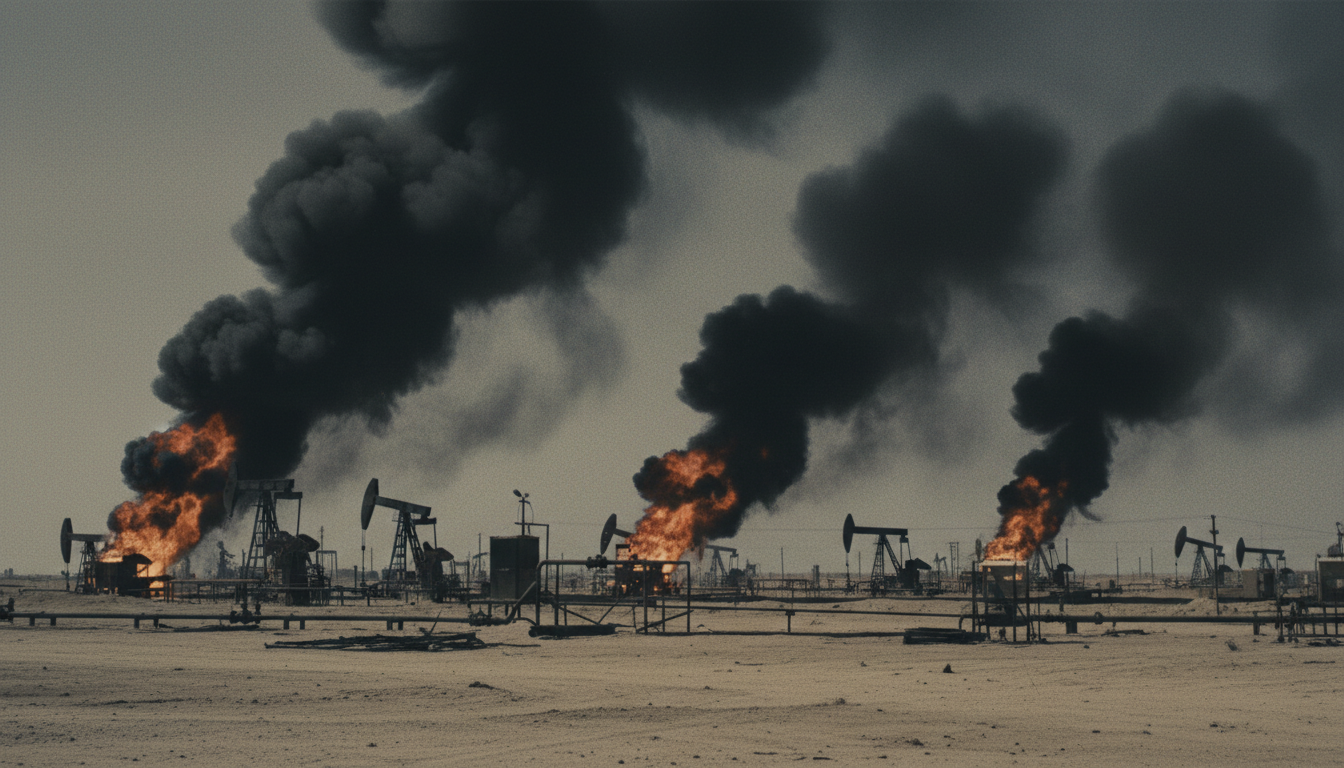
As Iraqi forces left Kuwait in early 1991, they set fire to oil wells, storage tanks, refineries, and related facilities across the country’s fields. Black plumes rose high enough for satellites to track day after day.
As Iraqi forces left Kuwait in early 1991, they set fire to oil wells, storage tanks, refineries, and related facilities across the country’s fields. Black plumes rose high enough for satellites to track day after day. Firefighting crews fought for months; the last well was capped on 6 November 1991. Officials called it environmental sabotage and, in some U.S. framings, eco-terrorism. The Archive tension is not whether the wells burned—that is settled theater fact. It is how EPA interagency monitoring and DoD exposure reports measured the smoke, what they claimed about near-term risk, and how those claims sat beside later veteran-health debates without collapsing into either nuclear-winter folklore or “nothing to see” denial.
The Product: Scorched Infrastructure as Strategy
Destroying Kuwait’s oil plant was wartime resource denial made visible. Estimates in U.S. packets place damaged or burning wells and facilities in the many hundreds—EPA’s Report to Congress language cites over 700 oil wells, storage tanks, refineries, and facilities set afire or damaged by the retreating Iraqi army. Daily burn rates in the uncontrolled phase ran into millions of barrels of oil and huge volumes of gas. Oil lakes and fire trenches added ground contamination to the airborne plume. That is the product: industrial combustion at national scale, lit on purpose.
Official Posture: Measure the Plume, Fight the Fires
Washington deployed an Interagency Air Assessment Team—EPA, NOAA, HHS, with in-country support from Coast Guard, DoD, and DOE—working with Saudi and Kuwaiti authorities from March 1991. The posture was technical assistance and health-risk reconnaissance, not press-release meteorology. DoD later built GulfLINK environmental exposure reports specifically for U.S. personnel who lived under the smoke. VA public-health pages now point veterans to oil-fire exposure as a recognized Gulf War exposure category. Firefighting itself became an international industrial campaign until November.
The 3 April 1991 Interagency Interim Report describes more than 500 fires then raging and outlines reconnaissance sampling aimed at sulfur dioxide, hydrogen sulfide, particulates, and related plume chemistry to judge immediate threats. The fuller Report to Congress covers U.S. Gulf environmental technical assistance from late January through July 1991—the bureaucratic spine of what Washington thought it was doing in theater. DoD’s Oil Well Fires Environmental Exposure Report on GulfLINK compiles troop-location monitoring, especially the U.S. Army Environmental Hygiene Agency (later CHPPM) campaign from May through early December 1991, with thousands of samples after many fires were already out. Conclusions in that DoD lane stressed that many measured concentrations sat below U.S. occupational benchmarks used for comparison, while still listing lessons on surveillance, risk management, and information management—and flagging areas needing more research. That combination—reassuring occupational comparisons plus open research gaps—is the documentary so-what, not a meme.
Pre-war and early-war commentary sometimes sketched regional climate catastrophe—darkened skies as near-apocalypse. Measured plume studies did not validate cartoon global nuclear-winter outcomes. The opposite management error treated “below occupational standards in many samples” as proof smoke was medically inert for every veteran. Gulf War illness research remains multi-cause in official frames; oil-fire smoke is one exposure among others (including oil-fire proximity as a modeled factor in later studies). Living commanders, EPA team leads, and researchers belong by role and report citation. Prefer well counts and dates inside EPA/DoD packets over viral tallies with no inventory.
From Satellite Plume to Ground Sample
Satellites made the sabotage undeniable; they did not finish the health ledger. Ground and aircraft sampling had to answer whether troops and civilians faced acute toxin levels that matched the visual horror. The answer in the interim EPA and later DoD packets was mostly: severe local nuisance and particulate loading, serious environmental destruction, not a uniform acute poison cloud at every unit location. That nuance frustrates both wartime propaganda that needed infinite villainy and later skepticism that needed infinite harm from every plume hour. Holding both truths matters: the burned billion-barrel-scale loss estimates, the November capping date, and the monitoring caveats stay on the same page.
Kuwait’s Fields as a Monitoring Grid
Burgan and the other major fields turned into both crime scenes and laboratories. Interagency teams needed Saudi and Kuwaiti cooperation for access; USAEHA/CHPPM later blanketed troop locations with sample schedules once the theater stabilized enough to instrument. The DoD exposure report’s tabs on geography, climate, demography, and Kuwait’s oil industry are not decoration—they are the grid that makes plume claims testable. When later veteran studies revisit modeled smoke exposure, they inherit that grid’s strengths and gaps. Prefer GulfLINK and EPA NEPIS doors to secondary essays that cite neither. The fires were bright enough for anyone to film; the dose question always required the boring paperwork of filters, labs, and location logs.
Siblings and Myth Discipline
Other scorched-earth oil denials and wartime port/refinery sabotage belong in the same environmental-warfare family. Kuwait’s recovery and well-control industry performance are aftermath, not exoneration of the act. Refuse claims that the fires alone “changed Earth’s climate permanently.” Refuse erasure of veteran exposure documentation. Keep sabotage intentionality explicit—this was not an accidental field fire.
Date discipline: ignition with Iraqi retreat February 1991; U.S. interagency air team from about 10 March 1991; Interagency Interim Report 3 April 1991; last well capped 6 November 1991; DoD GulfLINK exposure reporting updated through the late 1990s.
What the Paper Trail Settles
Settled on the documents: intentional large-scale ignition of Kuwaiti oil infrastructure; EPA interagency monitoring and Report to Congress technical-assistance record; DoD troop-exposure monitoring architecture and published conclusions with research gaps; VA recognition of oil-fire exposure as a Gulf War category. Overclaim to refuse: global climate apocalypse folklore; smoke as universally harmless; oil fires as the sole proven cause of all Gulf War illness. Officials said sabotage and measurement. The paper trail says both happened—and the Archive holds the burn and the sample sheets together.