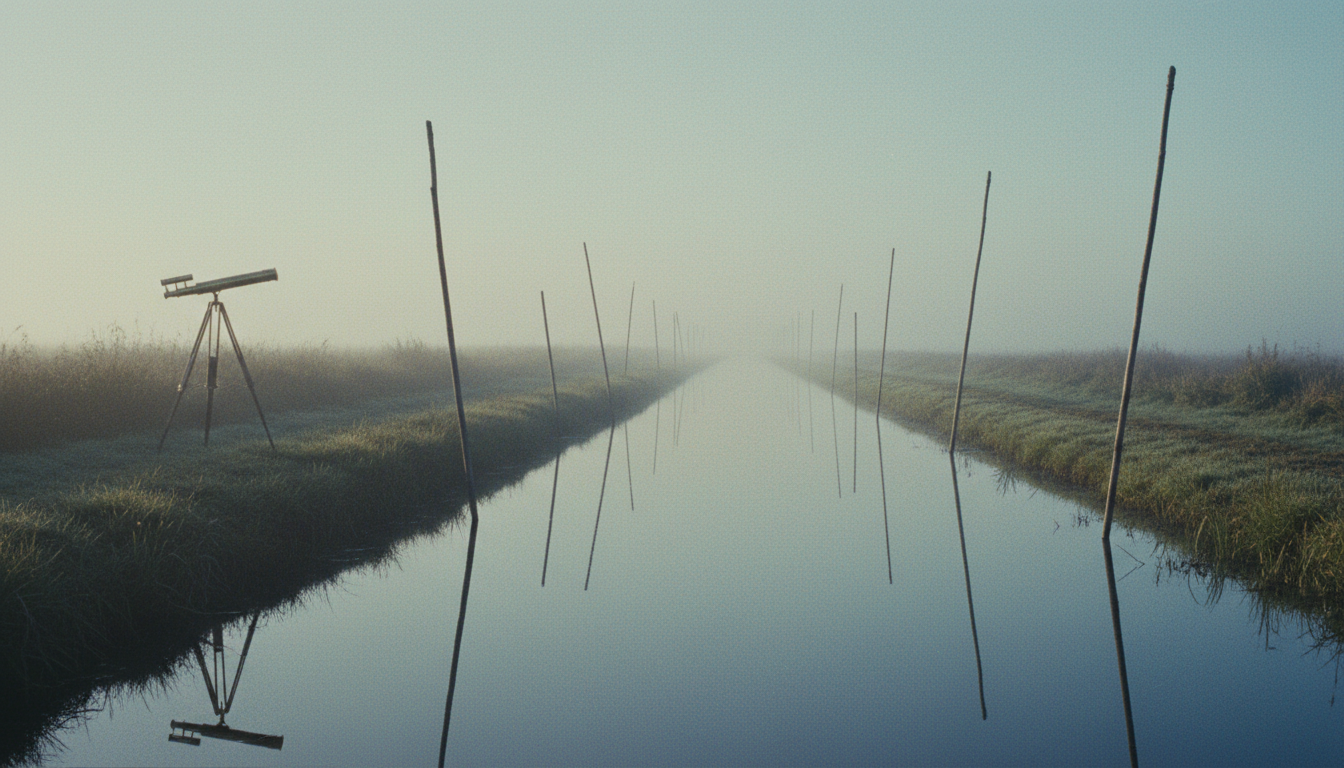
Old Bedford canal sightings are still read two ways: as a measured curve, and as evidence the earth is flat. The water is the Old Bedford, a straight cut through the Cambridgeshire fens. In 1865 an author signing himself Parallax printed one observation and concluded the earth is not a globe. In 1870 Alfred Russel Wallace accepted a wager to measure convexity on that water. Referees split. A 1904 pamphlet read a later photograph as support for the plane. The distrust is named in those pages: of the telescope, of the level, and of the globe reading itself.
The 1865 observation, in the author's words
Project Gutenberg's text of Zetetic Astronomy: Earth Not a Globe!, by "Parallax," describes the Old Bedford as an artificial river upwards of twenty miles long, nearly straight, with no locks. A boat with a flag three feet above the water sailed from Welney Bridge to Welche's Dam, six statute miles. The observer sat in the water, eye not more than eight inches above the surface, with a telescope. The text says the flag and the boat down to the water's edge stayed clearly visible the whole way. From that, it concludes the water did not decline from the line of sight. It calculates that, on a globe, the far boat would have stood more than sixteen feet below the line of sight, flag included. The chapter's own sentence follows: the surface of standing water is not convex, and therefore the earth is not a globe.
Zetetic Astronomy, Project Gutenberg: https://www.gutenberg.org/files/69892/69892-h/69892-h.htm
The wager, in Wallace's letters
A Western Kentucky University transcription prints letters from Alfred R. Wallace to John Hampden, taken from a pamphlet titled Is Water Level or Convex After All? On 15 January 1870 Wallace wrote from 9 St. Mark's Crescent that he would stake five hundred pounds to show visibly, and to measure in feet and inches, the convexity of a canal or lake. He signed Alfred R. Wallace, F.R.G.S. A memorandum of 8 February 1870, signed by Wallace and Hampden, says each had deposited five hundred pounds at Coutts' Bank. If Wallace, by 15 March 1870, proved the convexity and curvature, to and fro, of a canal, river, or lake, to the satisfaction of John Henry Walsh, of 346 Strand, and William Carpenter, of Lewisham, or of an umpire if those two differed, Wallace would receive the thousand pounds. If he failed, Hampden would. Wallace is the experimenter in that agreement. He offers measurement. He does not, in these letters, narrate the March result.
Wallace's letters to Hampden, with the 8 February 1870 agreement: https://people.wku.edu/charles.smith/wallace/S179AA.htm
The Field pages: three readings of one setup
A two-page scan from The Field, preserved on the same Wallace site, carries Carpenter's report as Hampden's referee, diagrams signed by M. W. B. Coulcher, and Walsh's decision. Carpenter dates the work to 6 March 1870, Old Bedford Bridge to Welney Bridge, six miles, signals centred 13 feet 4 inches above the water, a lower disc left at 9 feet 4 inches, a four-inch telescope, and a Stanley level. His conclusion is that the trial was inconclusive and that Wallace had not proved convexity.
Coulcher's certificate on the same pages, dated 7 March, says Wallace demonstrated the convexity of the surface of water on the Old Bedford on 5 March 1870, entirely to Coulcher's satisfaction. The diagrams are dated 5 March, from both bridges. Walsh, writing on 18 March from 346 Strand as the referee appointed because the umpires could not agree, says Wallace proved, to Walsh's satisfaction, the curvature to and fro of the Bedford Level Canal between Welney Bridge and Welch's Dam, six miles, to the extent of five feet, more or less, and proposes to pay Wallace the thousand pounds at Coutts's. The same scan thus dates the work to 5 March and, in Carpenter's report, to 6 March, and it names both Welney-to-Old-Bedford and Welney-to-Welch's Dam. Carpenter denies the curve. Coulcher and Walsh affirm a curve of about five feet. That split is the record.
The Field pages, Carpenter, Coulcher, and Walsh: https://people.wku.edu/charles.smith/wallace/zCarpenter1870Field1.pdf
Wallace answers Carpenter
Wallace's own letters to The Field, 2 April and 16 April 1870, answer Carpenter. He writes for readers not conversant with practical geodesy. He says he proved the central signal five feet above a straight line joining the ends, in the ordinary sense of that phrase, and that the middle signal sat below the level's cross-hair. The large telescope, he writes, showed about five and a half feet of curvature at the middle signal, three miles off. He appeals to the surveyor's test: eye at one end, to see whether the nearer point hides the farther.
Wallace in The Field, 2 and 16 April 1870: https://people.wku.edu/charles.smith/wallace/S162-163.htm
Parallax returns to the canal
In 1870 the same author, Parallax, issued Experimental Proofs. He writes that the 1865 book was meant to prove the earth an irregular plane, not a globe, and that John Hampden of Swindon wrote in October 1869, after reading it, that the rotundity doctrine was fallacious. Parallax says he complained of epithets in Hampden's press advocacy. On 5 April 1870 he went to the canal, saw through Welney Bridge's arch, and writes that on a globe of 26,000 miles the arch should have stood below the line of sight. From a boat, telescope 18 inches up, he says a notice board and a sluice stayed visible for six miles. He attributes the reported depression to aberration and collimation error, not curvature. The scan's file record lists Rowbotham among its keywords; the pamphlet speaks as Parallax, the name on the 1865 title page.
Experimental Proofs, Parallax, 1870: https://people.wku.edu/charles.smith/wallace/zParallax1870ExperimentalProofs.pdf
A 1904 photograph, read as the same evidence
Lady Blount's pamphlet The Collapse of the Globe Theory reprints a photograph on the Bedford Level and a letter from E. Clifton, for J. H. Dallmeyer Ltd., Newman Street, London. The test, it says, was 11 May 1904, camera under two feet high at Welney, six miles from a screen near Bedford Bridge. Clifton writes that he arrived sure the sheet would be invisible, then watched its lower edge and focused it. He will not drop the globular theory off-hand, but says that unless light curves, these six miles present a level surface. The pamphlet goes further: no curvature exists, and Parallax, Hampden, Carpenter, and the zetetics were right. Clifton's letter stops short of that sentence. Readers who take the canal as evidence the earth is flat are reading it as this pamphlet reads the photograph. Wallace, Coulcher, and Walsh describe a measured curve on the same kind of sight.
Lady Blount, The Collapse of the Globe Theory, with Clifton's letter of 11 May 1904: https://www.theflatearthsociety.org/library/pamphlets/Collapse%20of%20the%20Globe%20Theory%20(Lady%20Blount).pdf