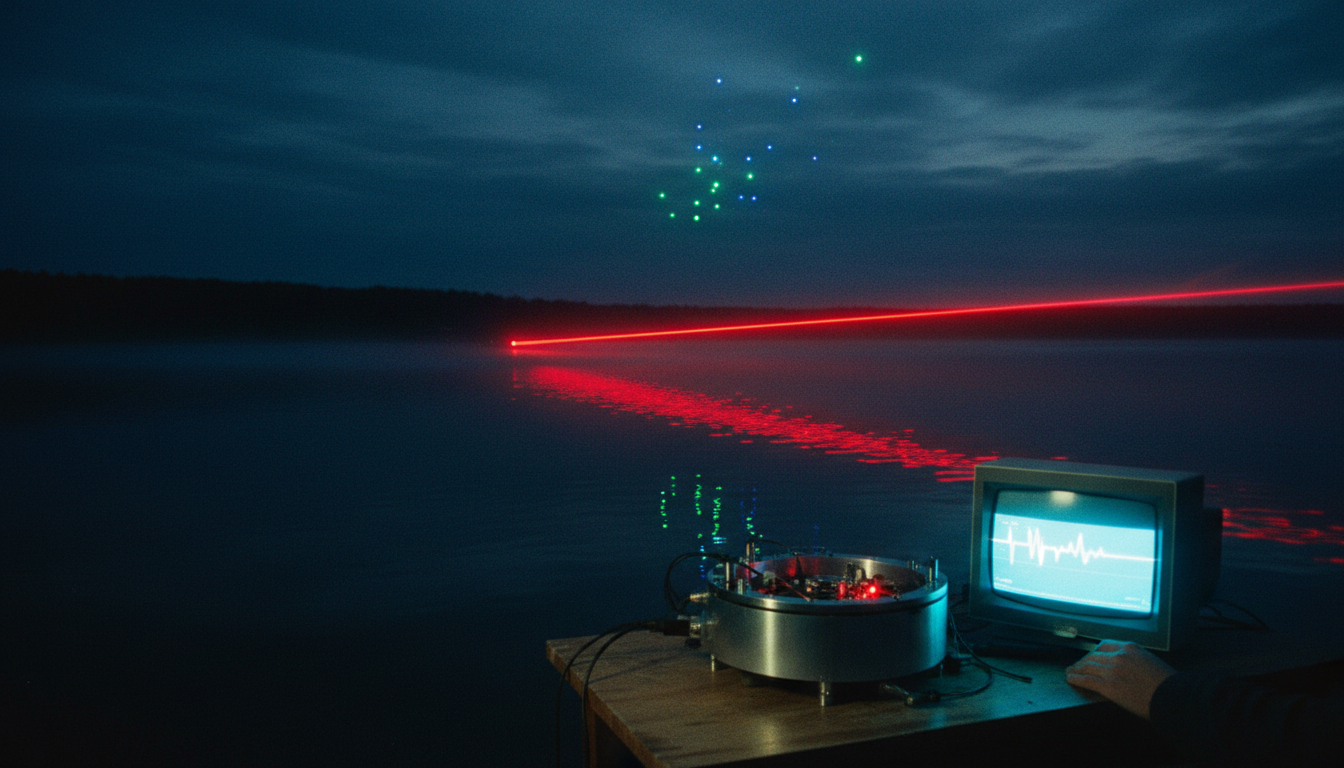
The fight is whether level, laser, and horizon videos are a live test that the ground does not curve. A 2018 study describes the uploads as a present practice. Three 2019 reviews describe runs inside one documentary and disagree on the gyroscope’s price. An 1865 canal book states the method the study says the videos restage. A 1982 survey memorandum corrects refraction on precise leveling and does not name the uploads.
What the 2018 study says the videos do
John C. Paolillo, First Monday, Volume 23, Number 12 (3 December 2018; received 12 January 2018, accepted 27 November 2018), examined several hundred videos and a timeline from YouTube metadata. On direct experiment he writes that the most common form is a reproduction of Rowbotham’s Bedford level experiment: telescopic lenses, lasers, electronic sensors, and cell-phone applications, set against curvature predictions that use a formula he traces to Rowbotham (1849). He writes that the experiments systematically fail, and that the failure is taken to disprove curvature and to confirm a flat ground. He also writes that only one premise is questioned. Instrument properties, atmospheric refraction, and mis-application of the formula are left unopened. On the horizon, he writes that long-zoom shots are offered to show that boats do not disappear hull first at sea level, and that NASA and station footage is used to “correct” curved horizons. His appendix lists, among others, “LASER TEST #1: Results and Re–Test: Flat Earth Experiment Phase 2” (26 June 2015), “Flat Earth — Bedford Level Experiment 2016” (15 July 2016), “Flat Earth | Laser Test Proves The Flat Earth — Part 2” (5 September 2016), and “Proving the Earth is not Flat. Part 1 the Horizon” (11 June 2016). Those are his citations. The videos were not re-watched here. The article describes a practice active through 2017–2018, not a bench log of each run.
Paolillo, “The Flat Earth phenomenon on YouTube,” First Monday 23, no. 12: https://firstmonday.org/ojs/index.php/fm/article/download/8251/7693
The canal method named in that study
The text he points to is Zetetic Astronomy: Earth Not a Globe!, by “Parallax,” London and Bath, 1865. The Old Bedford, an artificial river, runs straight for upwards of twenty miles through the fens, with no locks. A boat with a flag three feet above the water sailed from Welney Bridge to Welche’s Dam, six statute miles. The observer sat in the water with a telescope, the eye not exceeding eight inches above the surface. The book states that the flag and the boat, down to the water’s edge, stayed visible the whole distance, and concludes that the water did not decline from the line of sight. The calculation printed there is the square of the remaining five miles times eight inches, 200 inches: the boat, it says, would have been more than sixteen feet below the line of sight if the surface were convex. The next claim in the book is that standing water is not convex, and therefore that the Earth is not a globe. That is the 1865 inquiry’s own conclusion. It is not a rerun of a named upload.
“Parallax,” Zetetic Astronomy (1865), Project Gutenberg: https://www.gutenberg.org/cache/epub/69892/pg69892-images.html
Three reviews of one film, two prices
Laura Jane Turner’s account of Daniel J. Clark’s Behind the Curve (Digital Spy, 14 March 2019) names Jeran Campanella and Bob Knodel as hosts of Globe Busters, and reports Campanella’s line that the scientific method is the best way to get to the truth. Knodel is quoted on the rotation test: if the earth spins once every 24 hours, every hour it has to turn 15 degrees. They bought a ring-laser gyroscope for $20,000. The account says they found a drift of 15 degrees per hour, and quotes him: “Obviously we were taken aback by that. That’s kind of a problem.” It says they were not willing to accept the findings, and quotes a later remark that the rotation was not looking good and that what he had said was confidential. A further test used lasers across more than three miles: a beam cutting three points at one height would mean a flat surface; otherwise, curvature. The account says the laser was dropped and the same principle applied to a bright light, and that the review’s reading of the last scenes is that the results showed curvature. That sentence is the review’s, not an instrument log.
Kendra Reed (AIPT, 22 March 2019) writes that engineers in the community ran a few short experiments on screen, two of them with a $20,000 ring-laser gyroscope, and that each aligned with results expected for a globe. She writes that the results were not taken as valid, and that the next step was to work backward from a flat conclusion. John Timmer (Ars Technica, 17 March 2019) writes that the film includes at least two experiments meant to show the Earth flat, one of them a gyroscope bought for $10,000. He writes that the gyroscope shows the Earth rotating, and that the person who ran it treated the reading as something else rotating, perhaps the stars, and tried to isolate the instrument. The price in this third account is $10,000, not $20,000. The film was not viewed apart from these reviews. Three write-ups, two prices.
Turner, Digital Spy, 14 March 2019: https://www.digitalspy.com/tv/ustv/a26819931/flat-earth-science-behind-the-curve-netflix-mark-sargent-patricia-steere/
Reed, AIPT, 22 March 2019: https://aiptcomics.com/2019/03/22/documentary-behind-the-curve-looks-to-build-bridges-between-the-science-and-flat-earth-communities/
Timmer, Ars Technica, 17 March 2019: https://arstechnica.com/science/2019/03/behind-the-curve-a-fascinating-study-of-reality-challenged-beliefs/
A leveling correction that does not list the videos
Emery I. Balazs and Gary M. Young, Corrections Applied by the National Geodetic Survey to Precise Leveling Observations (NOAA Technical Memorandum NOS NGS 34, Rockville, June 1982), describe six corrections meant to limit known systematic errors on precise leveling. One is a refraction correction, modeled for temperature and density differences in layers of air. The memorandum says refraction and astronomic corrections have been applied to leveling data since 1973. The refraction term it prints is a simplified form of a model by T. J. Kukkamaki (1939): millimeters for a section, from section length, number of setups, a predicted temperature difference between 2.5 meters and 0.5 meters above the ground, the elevation difference, and a weather factor tied to sun and cloud. The memorandum is an agency account of how a survey line is adjusted. It does not name the 2015–2016 titles, the Bedford canal book, Globe Busters, or the documentary. A formula for survey refraction is not, on these pages, a verdict on an upload the memorandum never lists.
Balazs and Young, NOAA NOS NGS 34 (June 1982): https://www.ngs.noaa.gov/PUBS_LIB/TMNOSNGS34.html
What still stands as the fight
Paolillo itemizes the level, laser, and horizon practice, and he writes both that a missed drop is taken inside the videos as confirmation and that refraction and the instruments are left unopened. Turner and Reed print a $20,000 gyroscope; Timmer prints $10,000. The 1982 memorandum corrects refraction on the Survey’s own leveling and does not replace a named upload. The videos remain a live test beside those doors.