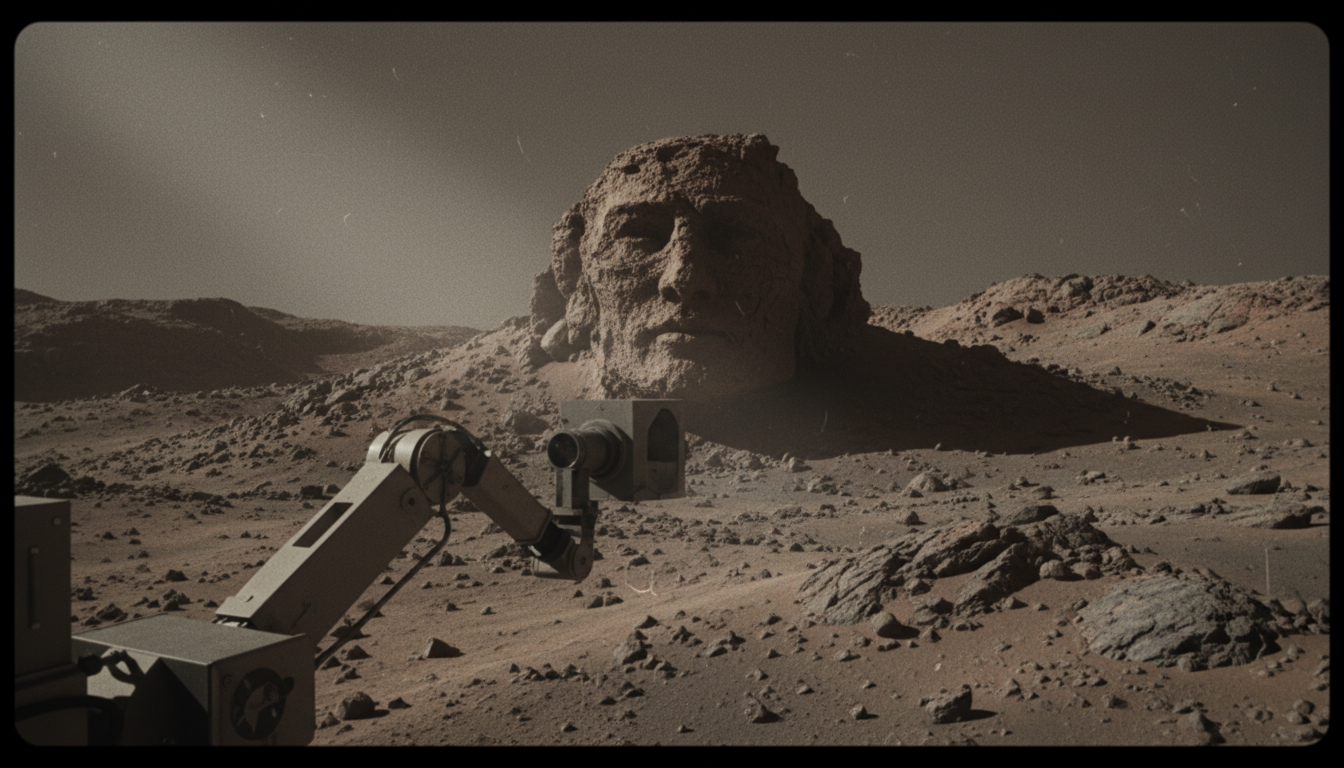
On 25 July 1976, Viking Orbiter 1 recorded frame 035A72 over Cydonia while hunting a landing site for Viking 2. Six days later the Viking News Center caption for press release P-17384 described eroded mesa-like landforms and said the central rock formation resembled a human head because of shadows—an illusion at roughly twenty degrees sun angle, about 1.5 kilometers across, speckled by bit errors. That sentence is the official spine. What followed was a decades-long argument about whether later images would reveal a carved monument or an ordinary hill under better light.
Frame 35A72
The ASU Mars Image Explorer lists 035A72 with acquisition time 1976-07-25T15:25:14Z, clear filter, and Cydonia coordinates near 41°N. At Viking visual-imaging resolution—tens of meters per pixel in the popular enlargements—the combination of late-day lighting, coarse sampling, and compression artifacts produced a face-like pattern that human viewers lock onto immediately. Pareidolia is not a slur. It is the documented mechanism the caption itself named: shadows giving the illusion of eyes, nose, and mouth.
ASU Viking Image Explorer — 035A72: https://viewer.mars.asu.edu/viewer/viking/035A72
Official Posture: Illusion, Not Idol
NASA’s public language never treated the feature as architecture. The 1976 caption called it a rock formation and an illusion. Later NASA Science Photojournal pages keep the scare quotes and the geologic frame—“so-called Face,” “geologic formation”—rather than adopting fringe monument vocabulary. That continuity matters. Conspiracy retellings often invent a mid-1970s “admission of a Face” that the caption does not contain. What the caption admits is resemblance under specific lighting. What it asserts is erosion and shadow.
NASA Science — Mars Orbiter Camera Views the “Face on Mars”: https://science.nasa.gov/photojournal/mars-orbiter-camera-views-the-face-on-mars-best-view-from-viking/
NASA Science — Geologic “Face on Mars” Formation: https://science.nasa.gov/photojournal/geologic-face-on-mars-formation/
NASA Science — The So-Called “Face on Mars”: https://science.nasa.gov/photojournal/the-so-called-face-on-mars/
What Higher Resolution Returned
Mars Global Surveyor’s Mars Orbiter Camera imaged the landform on 5 April 1998 at about 4.3 meters per pixel—roughly an order of magnitude finer than the best Viking views commonly compared—and again under clearer conditions around 8 April 2001 near 1.56 meters per pixel. NSSDC’s Cydonia page records ranges, incidence angles, and side-by-side Viking 035A72 comparisons so readers can check geometry rather than trust a meme crop. The mesa’s “features” resolve into ridges, slopes, and knobs. Eyes and mouth do not survive as carved cavities.
NSSDC — Cydonia Region of Mars: https://nssdc.gsfc.nasa.gov/planetary/mgs_cydonia.html
Mars Reconnaissance Orbiter’s HiRISE instrument then published observation PSP_003234_2210 (5 April 2007), titled as a popular landform in Cydonia. The HiRISE product is the current high-resolution public door: an eroded rocky mesa consistent with regional buttes and knobs, not a funerary monument. Fringe literature that treats every new pixel as further cover-up has to fight the instrument pages themselves.
HiRISE — PSP_003234_2210: https://www.uahirise.org/PSP_003234_2210
Why the Folklore Outran the Caption
Low resolution is a story amplifier. A face-like pattern at Viking scale is culturally sticky; a hill at HiRISE scale is boring. Tabloid and later fringe books built artificial-complex narratives—cities, pyramids, suppressed archaeology—around Cydonia neighbors that share the same lighting-and-pixel trap. The imaging chain does not require a conspiracy to explain the culture object. It requires human face-detection hardware pointed at a noisy orbital crop, then decades of motive-seeking when later data refused to cooperate.
The so-what for the Archive is pedagogical and documentary at once. Pareidolia plus resolution is how mysteries are manufactured and retired. Treating NASA’s early illusion language as a cover story inverts the paper trail: the agency named the illusion before the meme matured. Treating later geology as “debunk theater” ignores that MGS and MRO were mapping cameras with published footprints, not press-office sketches.
Resolution as the Real Plot
The cultural afterlife of 035A72 is easy to narrate as cover-up versus revelation. The imaging paperwork suggests a duller plot with a sharper lesson. Viking’s visual imaging subsystem delivered mapping frames adequate for landing-site geology, not for adjudicating meter-scale sculpture. When MGS and then MRO returned narrower footprints at finer ground sample distance, the “face” components failed the only test that mattered for an artificial claim: persistence under changing illumination and scale. NSSDC’s side-by-side with Viking 70A13 and 035A72 is useful precisely because it keeps geometry public. Readers can watch haze, incidence angle, and pixel scale do work that conspiracy captions assign to motive.
Instrument teams said the quiet part in product titles and captions. HiRISE called the target a popular landform in Cydonia. NASA Science keeps “so-called” in the URL-facing titles. Those are not embarrassed euphemisms. They are catalog discipline: the public name is acknowledged; the geologic claim is not surrendered. Fringe literature that demands NASA use monument vocabulary as a precondition of honesty is asking the Photojournal to launder a hypothesis the pixels did not earn.
Pareidolia pedagogy is the durable Archive value. Orbital crops will keep manufacturing faces, cities, and glyphs wherever coarse sampling meets human pattern hunger. The Face on Mars is the teaching case because the primary frame ID, the 1976 illusion caption, and the later meter-scale products all still open. Mystery retired by resolution is still a story. It is just not the story of a suppressed statue.
Contested Claims, Documented Chain
Settled on the documents: Viking 035A72 exists; the 1976 caption calls the head an illusion of shadows on an eroded mesa; MGS/MOC and HiRISE returned higher-resolution views of a natural landform; NASA Photojournal and NSSDC pages keep that geologic frame. Contested and labeled as such: artificial construction, a Cydonia monumental complex, or any claim that official caption language secretly confessed archaeology. Overclaim to refuse: viral “NASA admits the Face” slogans that rewrite P-17384, and the idea that refusal to treat a mesa as a statue equals a cover-up.
The tension that remains is cultural, not photometric. Officials said shadows. Crowds saw a face. Later orbiters returned a hill. The Face on Mars is that gap—read with the Viking frame ID and the HiRISE observation open, not with monument folklore doing the caption’s job.