HTLINGUAL
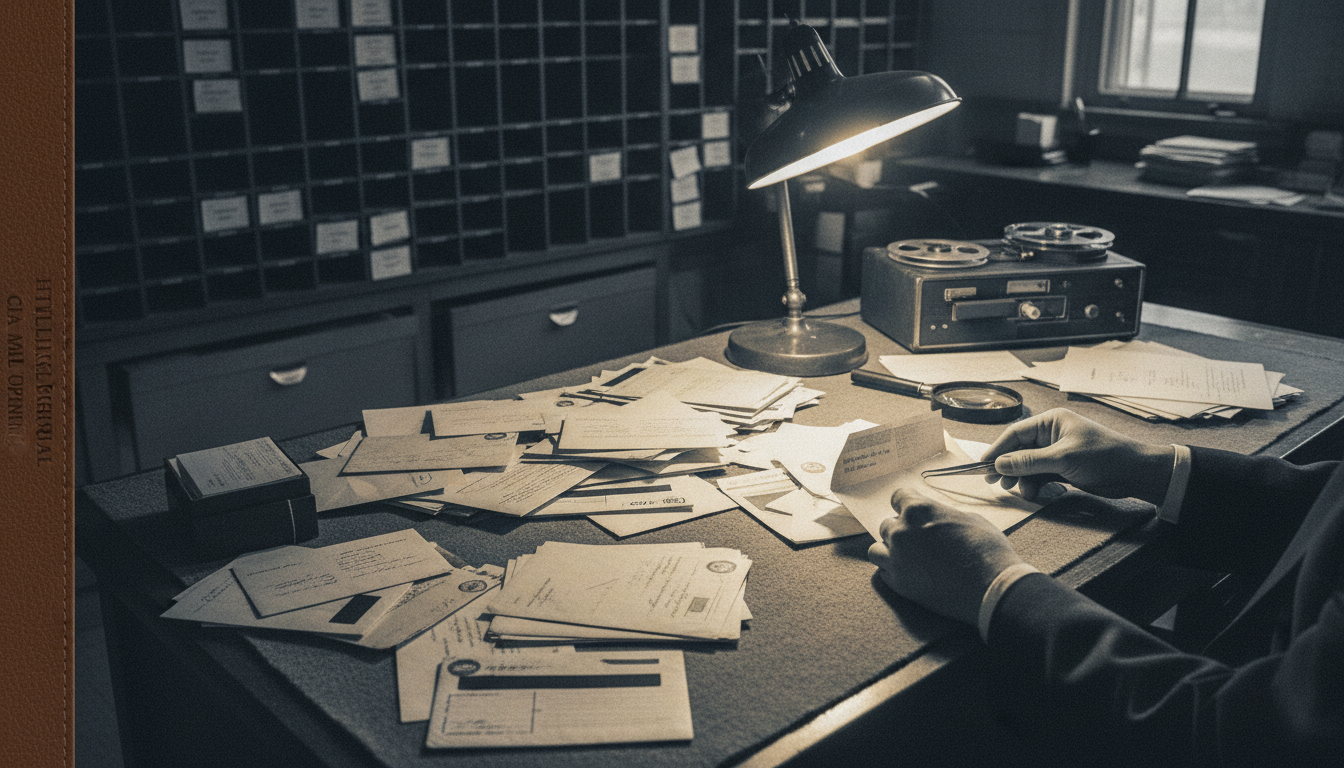
For years, certain letters crossing U.S. borders did not travel only through the postal service. They traveled through a CIA room where envelopes were steamed open, contents photographed, and seals restored. The cryptonym most often attached to that workflow is HTLINGUAL.
A Room Full of Other People's Mail
Church Committee investigators reconstructed a program that began in the early 1950s and continued into the 1970s. The operational logic was classic Cold War SIGINT hunger: correspondence to and from the Soviet bloc might reveal agents, scientists, or sympathizers. Watch lists grew. So did the temptation to open more mail than any warrant process would ever bless.
Technicians became skilled at nondestructive opening. Photographs went into Agency files. Recipients rarely learned that a foreign-intelligence service had read their private letters inside the United States.
Church Committee Findings
Book III of the Church reports did not treat HTLINGUAL as rumor. It treated it as established Agency practice that collided with postal law and the Fourth Amendment's spirit—even when lawyers invented internal rationales. The Rockefeller Commission covered related ground from the executive side. Together they forced a public reckoning: the CIA had run a domestic mail-intercept operation against Americans and others whose names landed on lists.
The numbers vary by source and year, but the order of magnitude is not small. Hundreds of thousands of items were screened; a substantial subset was opened. Exact tallies remain imperfect because record-keeping was itself a secrecy practice.
Not COINTELPRO, Not PRISM
COINTELPRO was an FBI disruption machine aimed at domestic politics. PRISM is a post-9/11 signals-collection architecture under statute and directive. HTLINGUAL is the mid-century paper analog: physical envelopes, steam, film. Linking them is about the recurring problem of secret reading of private communications—not about shared org charts.
Acoustic cyber-espionage and Room 641A elsewhere in the Archive show later technical mutations of the same appetite. HTLINGUAL is the analog ancestor that Senate investigators could hold in their hands as photographs of letters.
What the Record Settles
The CIA opened U.S. mail without the kind of judicial process a democracy pretends to require. That is settled. Open questions concern the full watch-list politics, the overseas liaison edges, and how completely successor practices were walled off after the 1970s reforms. Continuity claims need new documents. HTLINGUAL does not need them to remain historically solid.
Postal Law Meets Espionage Culture
HTLINGUAL's technicians were good at their craft. That craft competence is part of the moral problem. A clean reseal is not consent. Church investigators understood they were looking at a production line, not a handful of rogue steam kettles.
Modern readers reach for PRISM analogies too quickly. Digital selectors are not steamed envelopes. The analogy that survives is simpler: secret reading of private correspondence without a public warrant culture worthy of the name.