Operation CHAOS
By the late 1960s, Langley was not only watching Moscow. It was watching American campuses, antiwar offices, and radical newspapers. The program name that stuck in the investigative histories is Operation CHAOS.
Domestic Files in a Foreign Agency
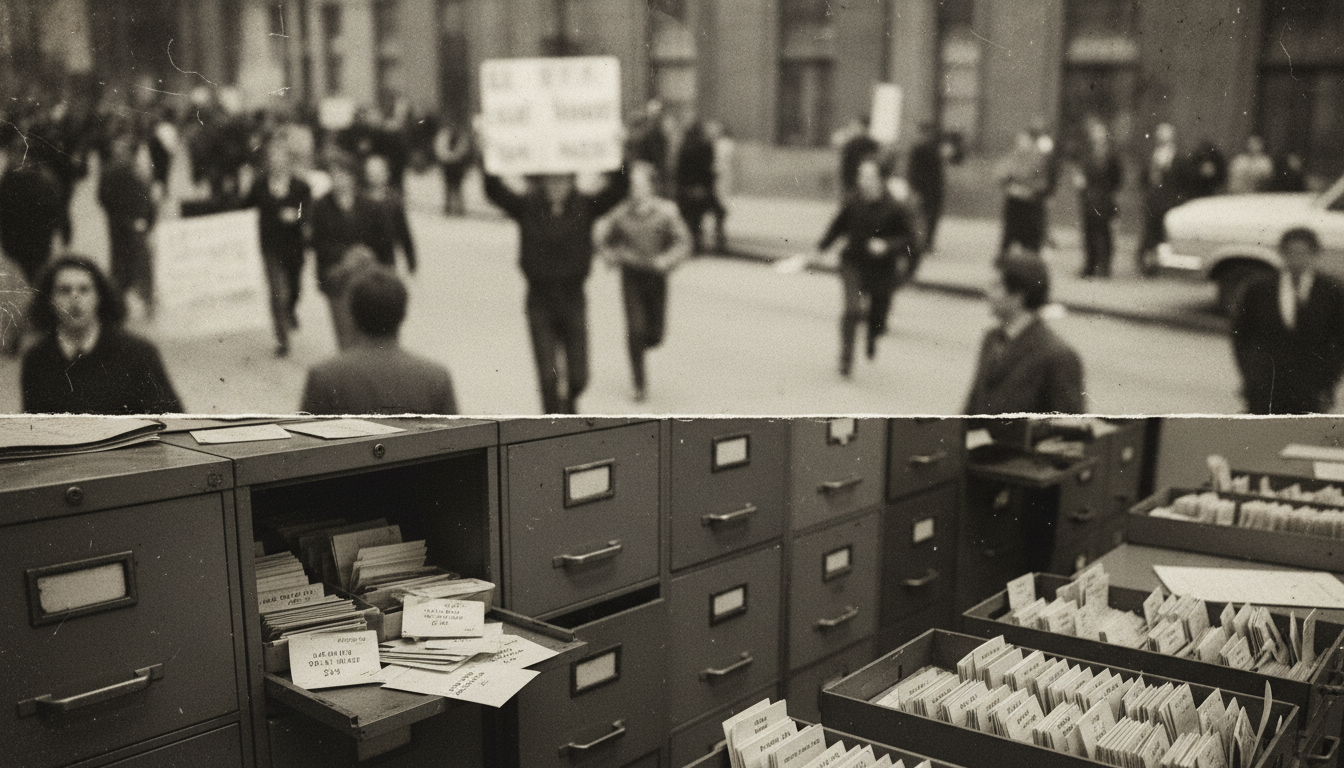
CHAOS grew from Agency fears that foreign powers were steering U.S. dissent. That hypothesis could have produced narrow, evidence-led inquiries. Instead it produced a growing domestic personality index: names, associations, travel, and political labels filed as if New Left organizers were overseas assets.
Rockefeller Commission staff and Church Committee investigators later counted files in the tens of thousands. The precise census depends on which index and which year you read. The direction of the finding does not: the CIA built a domestic surveillance archive far outside its public charter.
Methods Without Movie Scripts
CHAOS was not primarily a black-bag comedy. It was paperwork and penetration. Agents and informants reported on meetings. Open-source clippings fed dossiers. Coordination with the FBI created overlaps that later lawyers had to untangle. Some reporting touched celebrities because celebrity dissent was treated as influence topology.
MKUltra sits adjacent in public memory whenever "CIA" and "sixties" appear in one sentence. They are not the same program. CHAOS is political surveillance. MKUltra is behavioral experimentation. Both can be true at once without merging budgets.
Rockefeller, Church, and the Charter Problem
The mid-1970s investigations framed CHAOS as a case study in mission creep. A foreign-intelligence service had turned inward. Reforms that followed—oversight committees, tighter guidelines, cultural memory of "no domestic CIA police"—used CHAOS as Exhibit A alongside mail opening and assassination plots.
Fringe expansions that claim CHAOS never ended and simply changed stationery require successor documents. The Archive can say firmly what Rockefeller and Church established: during the Vietnam-era upheaval, the CIA ran a domestic spying program against Americans it associated with dissent.
Why Cross-Link COINTELPRO and PRISM
COINTELPRO shows the FBI's disruption toolkit in the same era. PRISM shows a later legal-technical species of bulk-ish collection. CHAOS is the Agency's domestic indexing story. Readers who want institutional literacy keep the three distinct while noticing the shared temptation: treat political opposition as a security file problem.
Index Cards as Weapons
CHAOS made dissent machine-readable inside Langley. That sentence should bother liberals and conservatives alike. Political policing by foreign-intelligence staff is a charter violation story before it is a left-right story.
When later activists claim every FBI fusion center is CHAOS reborn, ask for the file series. Continuity of temptation is plausible. Continuity of cryptonym is a claim.