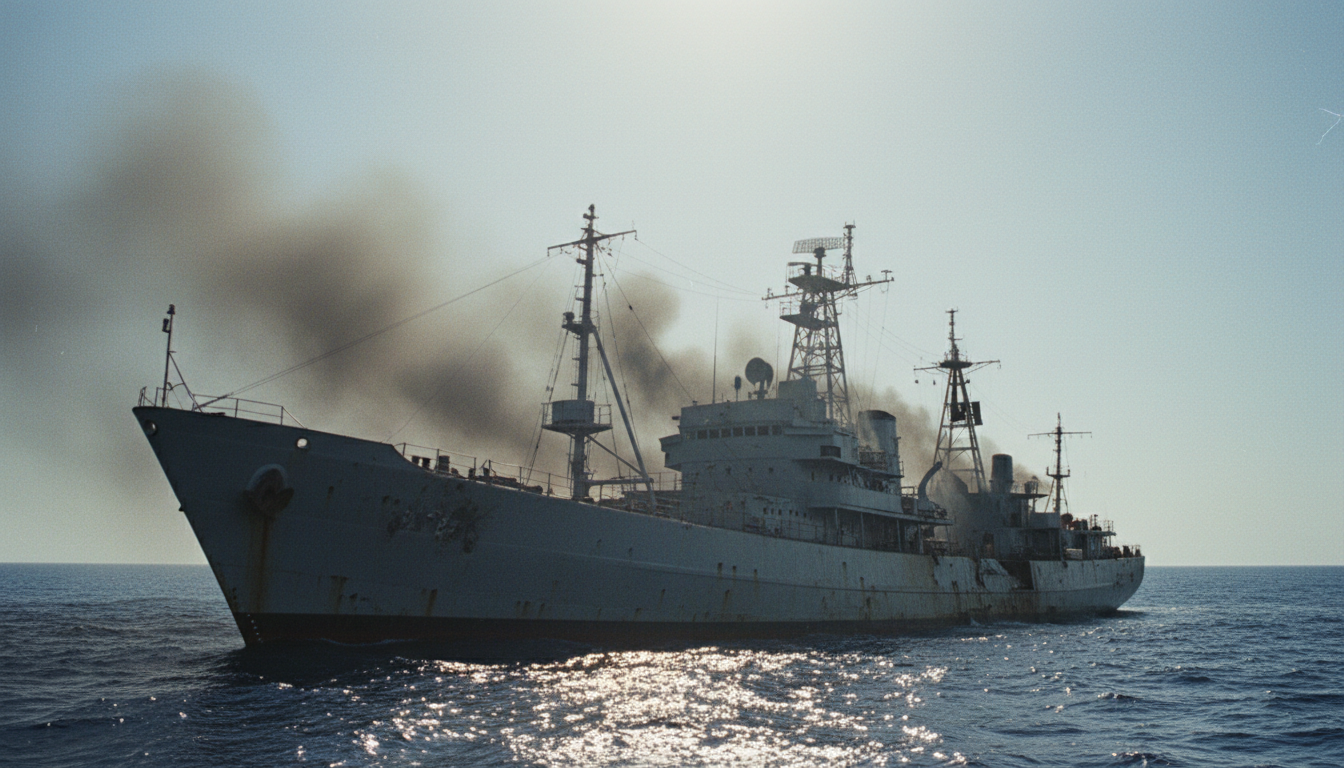
On 8 June 1967, during the Six-Day War, Israeli aircraft and torpedo boats attacked the U.S. Navy technical research ship USS Liberty (AGTR-5) in international waters off the Sinai. Thirty-four Americans died; scores were wounded. Israel called the attack a tragic case of mistaken identity and apologized. Survivors, some later official reviewers, and decades of secondary argument have contested that line. The Archive’s job here is narrow and documentary. Follow the National Security Agency’s FOIA releases of intercept transcripts and the Agency’s own cryptologic history. Record what those packets say—and what they refuse to close. Do not convert unfinished debate into a settled U.S. government cover-up verdict.
The Attack on a SIGINT Collector
Liberty was a converted Victory-hull SIGINT platform diverted toward the eastern Mediterranean to collect against the Middle East crisis. On the afternoon of 8 June she was strafed by jet aircraft, then struck by a torpedo that flooded the research spaces. Fires, machine-gun damage, and destroyed life rafts compounded the casualties. The ship limped toward Malta under escort. Caption-ready frames: the listing hull, the GTR-5 markings, the funeral details later. Those images are not the transcript fight. The fight is what U.S. intercept of Israeli helicopter and control-tower traffic showed after the attack—and how long that material stayed inside classified channels.
Official Posture: Mistake, Apology, Closed Inquiries
Israeli and U.S. executive statements quickly framed mistaken identity: Liberty supposedly confused with an Egyptian vessel in a war zone; apology and compensation followed. A U.S. Navy Court of Inquiry and later Israeli inquiries treated the attack as error rather than deliberate assault on a known American ship. That posture closed the story for many diplomats and for much of the contemporary press. It never closed the documentary fight for crew survivors, some congressional reviewers, and researchers who kept asking for the SIGINT record.
What the NSA Packets Actually Show
On 2 July 2003, and again around the fortieth anniversary in 2007, NSA posted audio and English transcripts of Hebrew voice communications between Israeli helicopter pilots and the control tower at Hazor (Hatzor) Airfield after the attack, plus a large historical-release collection of formerly classified traffic, sitreps, and studies. NSA’s own press language is careful: the Agency does not intend to prove or disprove any one set of conclusions; it intends to make material available for scholars to weigh. That disclaimer is part of the file. So are the transcripts.
NSA USS Liberty historical-release collection: https://www.nsa.gov/Helpful-Links/NSA-FOIA/Declassification-Transparency-Initiatives/Historical-Releases/USS-Liberty/
NSA/CSS press release on the 2007 document release: https://www.nsa.gov/Press-Room/Press-Releases-Statements/Press-Release-View/Article/1632655/nsacss-releases-documents-relating-to-the-8-june-1967-attack-on-the-uss-liberty/
A 13 June 1967 CIA intelligence memorandum published in the State Department’s Foreign Relations of the United States series compiled available sources—including references to those helicopter–tower intercepts—and concluded that the intercepts left little doubt the Israelis failed to identify Liberty as American before or during the attack, with identification crystallizing only afterward. That is contemporaneous U.S. intelligence language on the intercept theme, not a later memoir.
FRUS 1964–1968, vol. XIX, Document 284 (CIA memo, 13 Jun 1967): https://history.state.gov/historicaldocuments/frus1964-68v19/d284
NSA’s own cryptologic history, Attack on a SIGINT Collector, the U.S.S. Liberty (William D. Gerhard and Henry W. Millington, 1981; later declassified and hosted via the National Security Archive’s NSA briefing book), walks the collector’s mission, communications delays on recall orders, and the attack timeline from inside the SIGINT system. Lead with that institutional history beside the transcript collection—not with viral captions.
NS Archive / NSAEBB24 Document 10 (Attack on a SIGINT Collector): https://nsarchive2.gwu.edu/NSAEBB/NSAEBB24/nsa10.pdf
NS Archive NSAEBB24 briefing-book index: https://nsarchive2.gwu.edu/NSAEBB/NSAEBB24/index.htm
FRUS volume door for the 1967 Middle East crisis context around the memo: https://history.state.gov/historicaldocuments/frus1964-68v19
Contested Edges Without a Closed Caption
Deliberate-attack hypotheses cite the U.S. flag, clear weather, hull markings, the intensity of the assault, and alleged suppressed testimony. Mistake hypotheses cite war-zone confusion, failed identification channels, and the post-attack helicopter traffic in which controllers still scramble nationality questions. NSA’s published helicopter–tower transcripts are evidence about aftermath identification chatter; they are not, by themselves, a courtroom verdict on pre-attack knowledge. Treat “deliberate” versus “mistake” as contested where primary packets disagree or stop short. Treat a settled claim that the U.S. government ran a deliberate cover-up to protect Israel as an overclaim this page will not assert as fact. Disclosure fights, classification longevity, and inquiry narrowness are documentable. A closed conspiracy caption is not.
Myth Discipline
Reject slogans that erase the thirty-four dead. Reject slogans that treat every redaction as proof of a White House plot. Stick to NSA release portals, the FRUS CIA memorandum’s intercept language, and the Gerhard/Millington cryptologic history for what the SIGINT system recorded and when the public could read it. Secondary books and survivor memoirs matter as contested testimony; they do not outrank the FOIA packets on this page’s spine.
What the Paper Trail Settles
Settled on the documents: Israeli forces attacked USS Liberty on 8 June 1967; thirty-four Americans died; NSA later FOIA-released helicopter–tower audio/transcripts and a broad historical collection; a 13 June 1967 CIA memo in FRUS weighed those intercepts toward post-attack identification; NSA’s cryptologic history records the SIGINT-collector context. Overclaim to refuse: asserting deliberate U.S. government cover as settled fact, or treating the NSA disclaimer as empty when the Agency’s own release page states it will not referee conclusions.
The tension that remains is the one the FOIA packets leave open. Officials apologized for a mistake. Survivors and later reviewers kept demanding the intercept file. NSA eventually published transcripts and still refused to declare a winner. Read the releases beside the FRUS memo. The so-what is the gap between a 1967 closed apology and a public SIGINT record that scholars are still told to judge for themselves.